
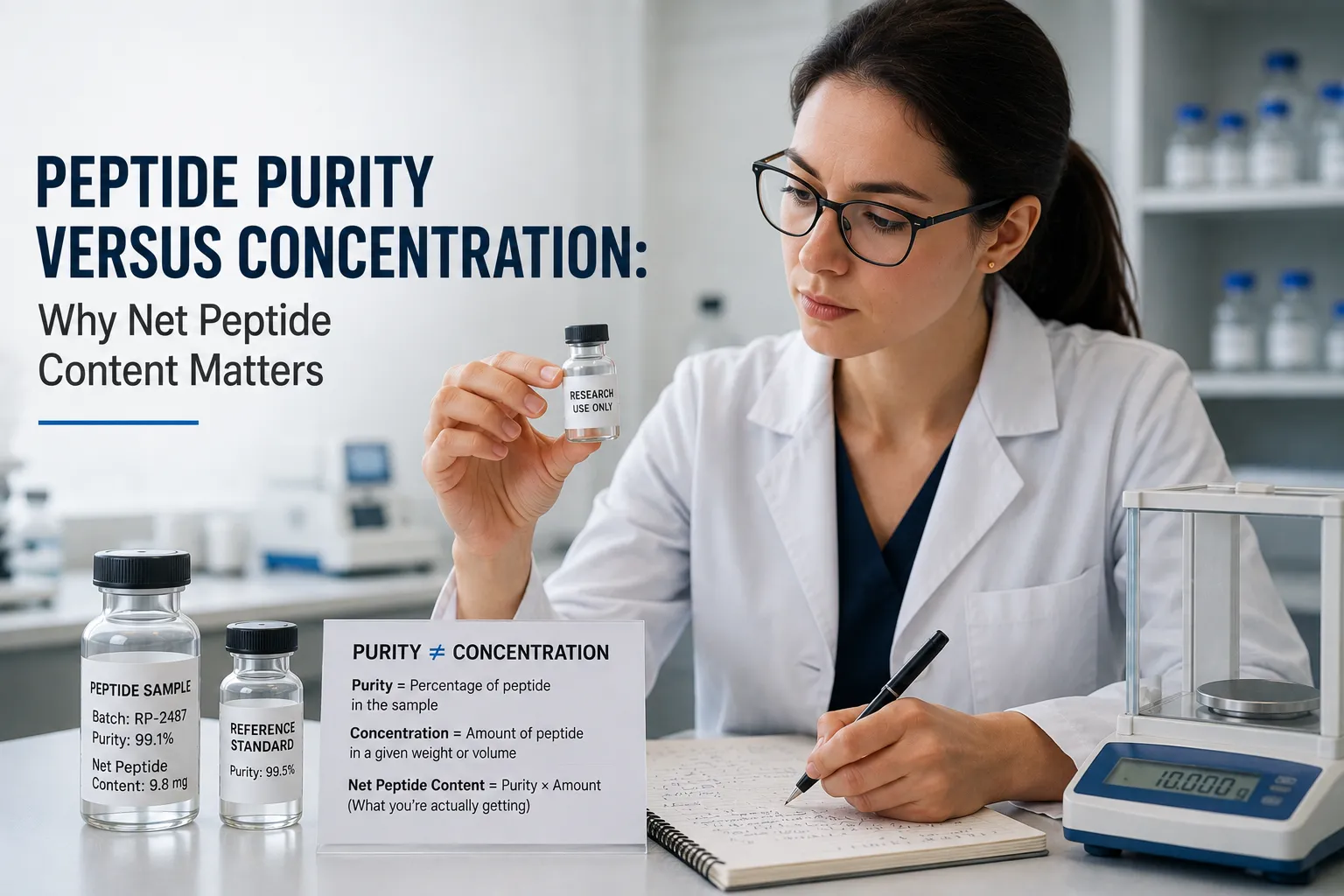
Three terms cause more confusion in peptide documentation than any others: purity, concentration and net peptide content. They are often used interchangeably, yet they describe entirely different things, and conflating them leads people to compare products that are not actually comparable. Understanding the difference is one of the most practically useful skills for anyone assessing peptide materials. This guide separates the three clearly.
This is general laboratory and documentation information. It is not usage guidance for any compound.
The short answer
Purity describes how much of the material is the target compound rather than impurities. Net peptide content describes how much of the vial’s mass is actually peptide rather than salt and water. Concentration describes how much peptide is present per unit of liquid once the material is dissolved. A product can be high in one and low in another, which is exactly why comparing products on a single number is so often misleading.
Purity: what proportion is the target compound
Purity is usually assessed by high performance liquid chromatography and expressed as a percentage, for example 98 per cent. It tells you what proportion of the detected material is the main compound, as opposed to related impurities and by-products. A high purity figure means the sample is mostly the intended molecule and not a mixture of contaminants.
What purity does not tell you is how much actual peptide is in the vial by mass, or how identity was confirmed, or anything about sterility. It is one attribute among several. The way purity is measured and presented on documentation is covered in detail in our guide on how to read a Certificate of Analysis.
Net peptide content: how much is actually peptide
This is the term most people have never heard of, and it is arguably the most important for fair comparison. Peptides are usually supplied as salts, commonly acetate or trifluoroacetate forms, and the freeze dried material also retains some water. The milligram figure on a label frequently refers to the gross mass of this salted, lyophilised material, which includes the counter ions and residual water alongside the peptide itself.
Net peptide content is the proportion of that gross mass that is actually the peptide. A vial labelled at a given milligram figure may contain a meaningfully lower quantity of actual peptide once the salt and water are accounted for. Two products can show the same headline milligram number and the same purity, yet contain different amounts of actual peptide, because their salt forms and net content differ.
Why salt form changes the maths
The salt form matters because different counter ions make up different proportions of the total mass. An acetate salt and a trifluoroacetate salt of the same peptide will have different net peptide content for the same gross weight. This is not a minor rounding issue. It can be a substantial difference, and it is invisible unless the documentation states both the salt form and the net content.
This is why a certificate that reports only a gross milligram figure, with no salt form and no net peptide content, is giving an incomplete specification. It is one of the most common ways in which two products that look identical on paper are not actually comparable, a point we also cover in our guide on understanding peptide vial labels.
Concentration: how much per unit of liquid
Concentration is a different axis again, and it only exists once a compound is reconstituted. It describes how much peptide is present per unit of the resulting solution, and it depends entirely on how much diluent was added. The same vial can produce very different concentrations depending on the volume of liquid used to dissolve it.
This is why concentration cannot be read off a dry vial’s label. The label describes total quantity, not concentration. Concentration is a property of the prepared solution, and preparing that solution is covered in our guide on reconstitution basics, using a diluent such as bacteriostatic water.
Putting the three together
The cleanest way to hold these apart is to think of three separate questions:
- Purity asks: of the material present, how much is the target compound rather than impurities?
- Net peptide content asks: of the vial’s total mass, how much is actually peptide rather than salt and water?
- Concentration asks: once dissolved, how much peptide is present per unit of liquid?
Each answers a different thing. A sample can be very pure yet have modest net peptide content because of its salt form. A vial can have high net content yet yield a low or high concentration depending purely on how it is reconstituted. Treating any one of these as a proxy for the others is the fundamental error.
How to compare products fairly
When comparing two peptide products, the headline milligram figure is the least reliable basis for comparison on its own. A fairer comparison looks at several things together:
- Purity, with the method stated and ideally a chromatogram included.
- Net peptide content, so you know how much actual peptide each vial holds.
- Salt form, since it determines the relationship between gross mass and net content.
- Batch specific documentation, so the figures relate to the actual material rather than a generic claim.
A product that discloses all of these is being transparent. A product that discloses only a gross milligram figure is leaving you unable to make a genuine comparison, whatever its price appears to say.
Why this protects buyers
Understanding these three terms is a direct defence against misleading value comparisons. A product can appear cheaper per milligram while actually offering less peptide, lower purity, or both, once the full specification is considered. The number on the front of the vial is a starting point, not the answer. The full picture lives in the batch documentation, which is why the ability to read a Certificate of Analysis, and to insist on one, is the practical foundation for everything else.
Frequently asked questions
What is the difference between purity and net peptide content?
Purity is what proportion of the material is the target compound rather than impurities. Net peptide content is what proportion of the vial’s mass is actually peptide rather than salt and water. They are different measurements.
Why is the milligram figure on a vial sometimes misleading?
Because it often refers to the gross mass of salted, freeze dried material, which includes counter ions and water. The actual peptide mass can be lower, depending on salt form and net content.
Does salt form really change how much peptide I get?
Yes. Different counter ions make up different proportions of the total mass, so the same gross weight can contain different amounts of actual peptide depending on the salt form.
Is concentration the same as content?
No. Content is the total peptide in the vial. Concentration is how much peptide is present per unit of liquid after reconstitution, which depends on how much diluent is added.
How do I compare two peptide products fairly?
Look at purity, net peptide content, salt form and batch specific documentation together, rather than relying on the headline milligram figure alone.
Key takeaways
- Purity, net peptide content and concentration are three different measurements.
- The label’s milligram figure is often gross salted mass, not actual peptide.
- Salt form determines how much of the gross mass is actually peptide.
- Concentration only exists after reconstitution and depends on diluent volume.
- Fair comparison needs purity, net content, salt form and batch documentation together.

