
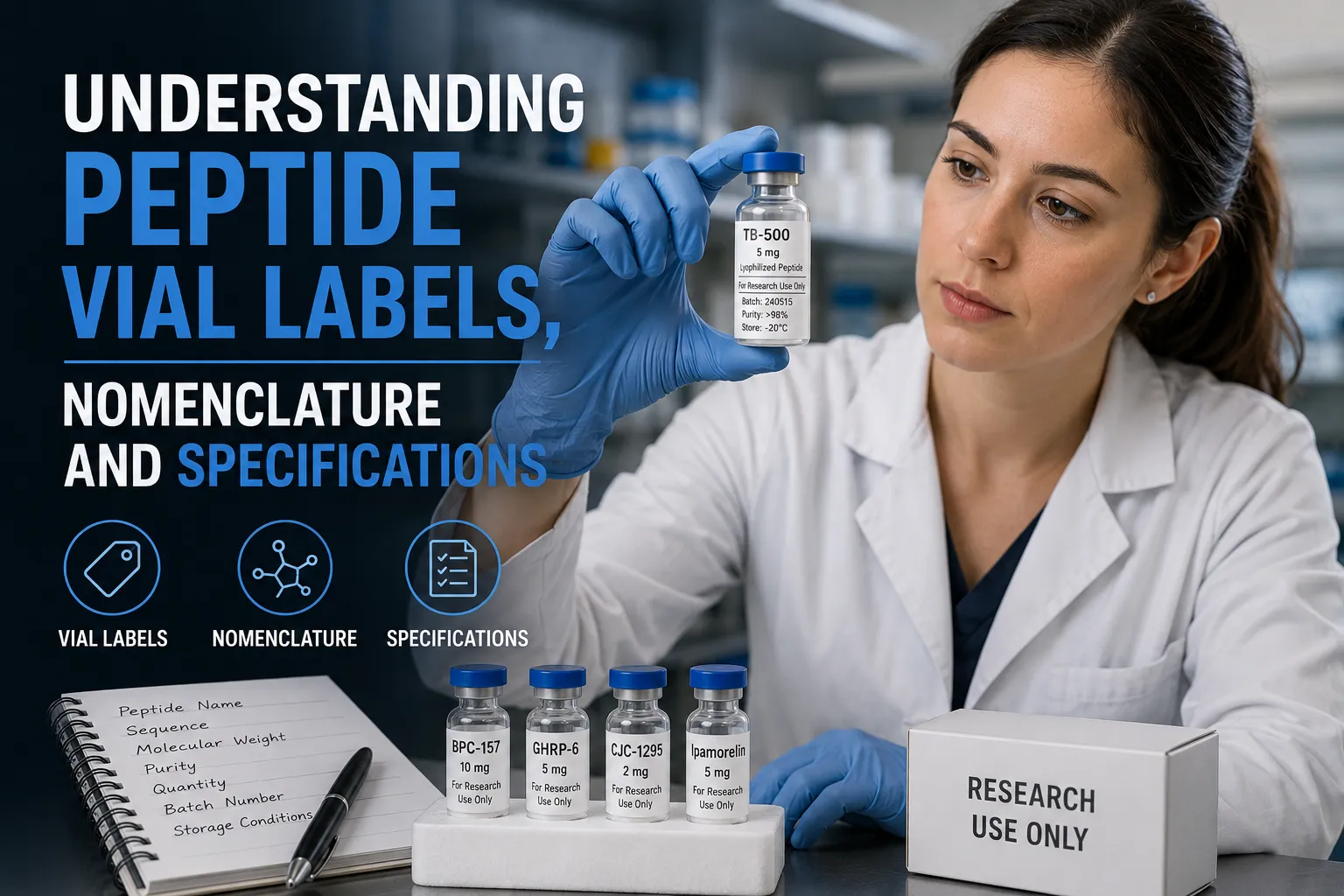
A research peptide vial carries a surprising amount of information in a small space, and reading it correctly is the difference between knowing what you have and merely assuming it. Naming conventions, strength figures, salt forms and batch codes each tell you something specific, and each is a point where a product can be misrepresented. This guide explains how to read a peptide label properly and what to verify against supporting documentation.
This is general laboratory information about product documentation and specifications. It is not usage guidance.
Why nomenclature is confusing
Peptides often carry several names at once. There may be a code name, a common or trade style name, a systematic chemical description, and one or more synonyms. The same compound can appear under different labels depending on the supplier, which makes cross checking essential.
For example, a single compound might be listed by an alphanumeric code, by a descriptive name, and by an abbreviation, all referring to the same molecule. When comparing products or documents, the reliable anchors are the objective identifiers rather than the marketing name, because those identifiers do not change between suppliers.
The objective identifiers to rely on
Three pieces of information identify a compound far more reliably than its name:
- CAS number, a unique registry identifier assigned to a specific chemical substance. Where one exists, it is the most dependable single identifier.
- Molecular formula, describing the exact atomic composition of the molecule.
- Molecular weight, the mass of the molecule, which should be consistent with the formula and is used in mass based verification.
When two documents disagree on the name but agree on these identifiers, they are describing the same substance. When they agree on the name but disagree on the identifiers, something is wrong.
Milligram strength is not the whole story
A label typically states a strength in milligrams. It is tempting to treat this as the amount of active peptide present, but that is often not accurate, because of how peptides are supplied as salts.
Most peptides are supplied as a salt, commonly an acetate or a trifluoroacetate form. The stated milligram figure frequently refers to the gross mass of the salted, lyophilised material, which includes counter ions and residual water alongside the peptide itself. The actual mass of peptide can be meaningfully lower than the number on the label.
Net peptide content and salt forms
This is where net peptide content becomes important. Net peptide content is the proportion of the vial’s mass that is actually the peptide, as distinct from counter ions and water. A vial labelled at a given strength may contain a lower net quantity of the peptide once the salt and moisture are accounted for.
The salt form matters for this reason. An acetate salt and a trifluoroacetate salt of the same peptide will have different proportions of counter ion, and therefore different net peptide content for the same gross mass. A thorough certificate states both the salt form and the net peptide content, which lets you understand what the milligram figure really represents.
A label or certificate that states only a gross milligram figure, with no salt form and no net content, is giving you an incomplete specification. This is one of the most common ways in which apparent value between products is not comparable.
Batch and lot codes
Every vial should carry a batch or lot code, and that code should match the certificate of analysis supplied with it. This is the thread that ties the physical material to its testing documentation. Without a matching code, a certificate is just a document about some other batch.
Batch codes also matter for traceability over time. If a quality issue emerges, the code is what allows a specific production run to be identified and isolated. A supplier that cannot provide batch level documentation cannot offer meaningful traceability, whatever else they claim.
Appearance and physical description
The label or certificate usually describes the expected physical appearance, commonly a white or off white lyophilised powder or cake. This description is a simple first check on receipt. Material that does not match its stated appearance, for example through discolouration, clumping or a collapsed cake, warrants closer scrutiny before anything else, because it can indicate moisture ingress or a thermal excursion in transit.
Storage information on the label
A complete label or accompanying certificate states the storage conditions for the material as supplied. These conditions are specific to the product and its formulation, and they take precedence over general rules of thumb. Following the stated conditions is what preserves the material’s integrity through its stated shelf life, a subject covered in more depth in this cluster’s guidance on peptide storage and stability.
Concentration, volume and simple arithmetic
One recurring source of error is confusing the strength on a label with the concentration of a prepared solution. The label describes the total quantity of material in the vial. The concentration only exists once the material is dissolved, and it depends entirely on the volume of diluent added. The same vial can yield very different concentrations depending on how much liquid is used to reconstitute it.
Because the label figure is frequently a gross salted mass rather than net peptide content, any calculation that treats the label number as pure active material will overstate what is present. For accurate work, the net peptide content from the certificate is the figure to use, not the headline milligram number on the front of the vial. This is one more reason the certificate, rather than the label alone, is the authoritative specification.
This distinction also explains why two products that appear identical on their labels can differ in practice. If one states net peptide content and salt form and the other states only a gross figure, they are not offering the same specification even when the milligram numbers match.
Putting it together: a label reading checklist
When assessing a vial and its documentation, work through the following:
- Identify the compound by CAS number, molecular formula and molecular weight, not just the name.
- Note the stated milligram figure and check whether it is gross or net.
- Find the salt form and the net peptide content, and understand what the strength figure actually represents.
- Match the batch or lot code on the vial to the code on the certificate of analysis.
- Confirm the appearance matches the stated description.
- Record the stated storage conditions and apply them specifically.
These checks apply consistently across the range. Whether a product sits in the peptides category or is a supporting item such as bacteriostatic water used for reconstitution, the principle is the same: the label makes claims, and the documentation is what substantiates them.
Frequently asked questions
Does the milligram figure on a vial equal the amount of peptide?
Often not. The figure frequently refers to gross salted mass, which includes counter ions and water. Net peptide content is the accurate measure of actual peptide.
What is a salt form and why does it matter?
Peptides are usually supplied as salts such as acetate or trifluoroacetate. The salt form affects how much of the gross mass is actually peptide.
What identifier is most reliable for a peptide?
Where one exists, the CAS number is the most reliable single identifier, supported by molecular formula and molecular weight.
Why must the batch code match the certificate?
A certificate only describes the batch it was issued for. If the codes do not match, the certificate is not evidence about the material in your hand.
What should I do if appearance does not match the label?
Treat it as a warning sign of possible moisture or thermal damage, and verify before relying on the material.
Key takeaways
- Identify compounds by CAS number, formula and molecular weight rather than by name alone.
- A milligram figure is often gross salted mass, not net peptide content.
- Salt form and net peptide content determine how much actual peptide a vial holds.
- The batch code must match the certificate of analysis for the documentation to mean anything.
- Follow the storage conditions stated on the label or certificate.

