
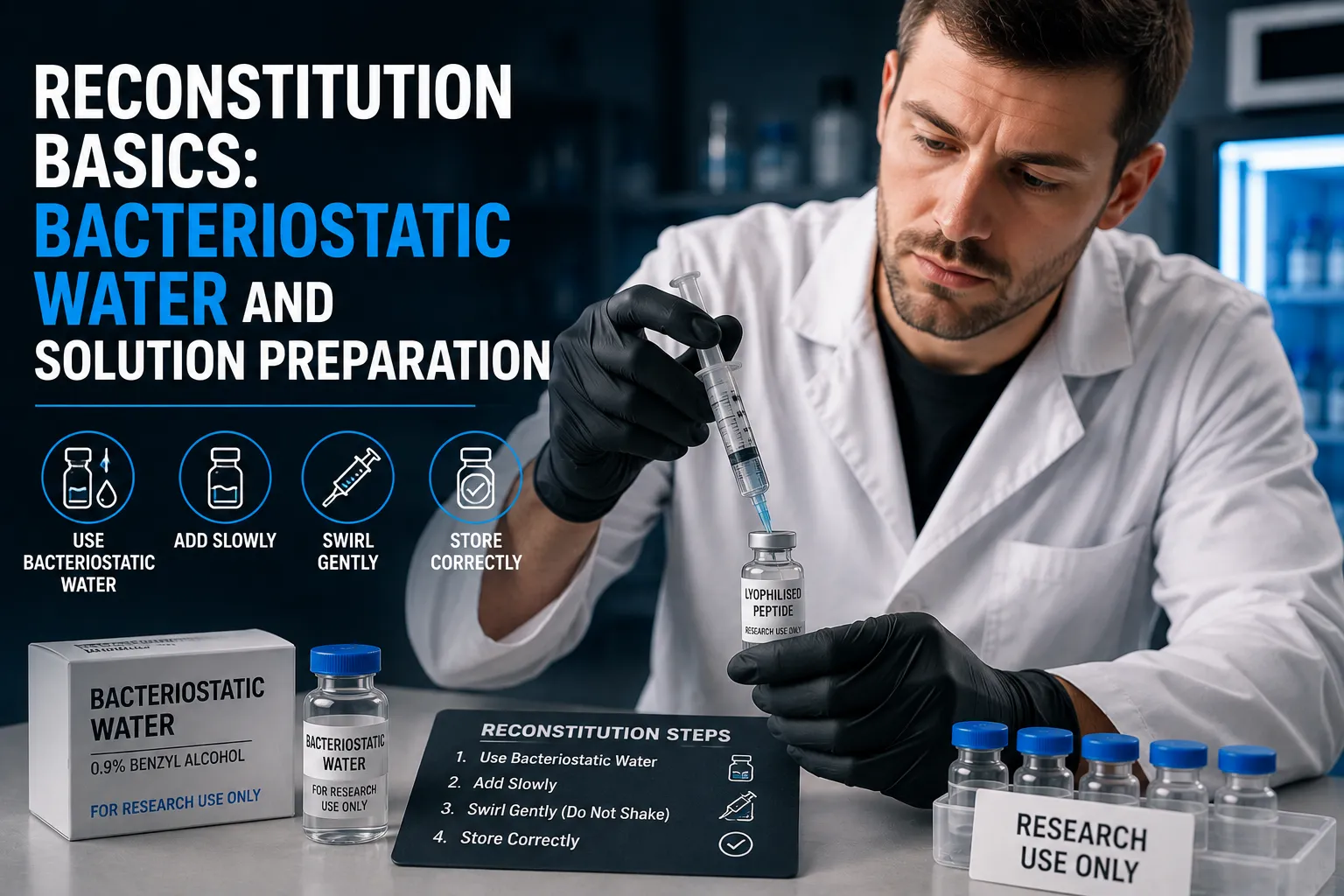
Reconstitution is the process of returning a lyophilised, freeze dried compound to a liquid state by adding a diluent. It sounds simple, and mechanically it is, but the choices involved have real consequences for the stability and integrity of the material. Understanding what bacteriostatic water is, how it differs from other diluents, and why handling technique matters is basic knowledge for anyone working with these materials in a laboratory setting.
This article explains the concepts and terminology. It is general laboratory information and not usage guidance for any compound.
What reconstitution means
Lyophilised material is supplied as a dry powder or cake because that form is far more stable than a solution. Reconstitution reverses that, dissolving the solid into a liquid by adding a measured volume of a suitable diluent. Once reconstituted, the material’s stability profile changes significantly, because the water dependent degradation pathways that lyophilisation was designed to prevent become active again.
This is why reconstitution is treated as the point at which a material’s usable life shortens. A compound that was stable for a long period as a powder becomes something that must be managed more carefully once it is in solution.
What bacteriostatic water is
Bacteriostatic water is water that contains a small amount of a preservative, most commonly benzyl alcohol, intended to inhibit the growth of bacteria. The preservative is what distinguishes it from plain water and is the reason it is often chosen as a diluent where a solution may be accessed more than once over a period of time.
The bacteriostatic property does not make the water sterilising, and it does not make a solution immune to contamination. It slows microbial growth. That is a useful property, but it is a supporting measure rather than a substitute for careful technique.
Bacteriostatic water versus sterile water
This is the distinction that causes the most confusion, and it is worth stating clearly. Sterile water for injection contains no preservative. It is intended for single use, because once opened it offers no ongoing protection against microbial growth. Bacteriostatic water contains a preservative and is therefore suited to situations where a container may be accessed more than once.
They are not interchangeable. They are different products with different specifications and different intended applications. Choosing between them is a real decision, not a matter of using whichever is on hand. You can see how bacteriostatic water is specified as a distinct product for exactly this reason.
Why the preservative matters
The presence of benzyl alcohol has two implications. The first is the benefit already described: it inhibits microbial growth, which is why bacteriostatic water suits multi access use over a limited period. The second is that the preservative itself is a consideration, because it is an additional substance in the solution. In some contexts a preservative free diluent is specifically required, which is precisely when sterile water rather than bacteriostatic water is indicated.
Understanding this trade off is the point. Neither diluent is universally correct. The right choice depends on how the solution will be handled and what the material and application require.
Aseptic technique
Whatever diluent is used, technique determines whether a solution stays clean. Aseptic technique is the set of practices that prevent the introduction of contaminants during handling. The core elements are straightforward but must be consistent:
- Clean the work area and use a clean surface for preparation.
- Disinfect vial stoppers before accessing them, using an appropriate wipe and allowing it to dry.
- Use sterile, single use consumables for each access rather than reusing items.
- Avoid touching surfaces that will contact the solution.
- Minimise the time containers are open and exposed to air.
Sterile single use consumables are part of this, and reusing or improvising them undermines everything else. Items such as insulin needles and alcohol wipes are supplied as single use for exactly this reason. Good technique is what preserves the benefit of a good diluent, and poor technique defeats it regardless of which water was chosen.
Solution stability after reconstitution
Once reconstituted, a solution is less stable than the original powder and should be stored and used accordingly. General laboratory practice is to store solutions refrigerated and to use them within a comparatively short window, with the exact period depending on the specific compound, the diluent and the pH. Some sequences are considerably more labile in solution than others.
Handling practices during this period also matter. Solutions are protected by using appropriate low adsorption containers, minimising agitation and headspace, keeping them cold, and protecting them from light. These are the same principles set out in this cluster’s storage and stability guidance, applied to the solution phase rather than the powder.
Common reconstitution mistakes
A handful of avoidable errors account for most compromised solutions. Understanding them is the quickest way to avoid them:
- Adding diluent forcefully by directing a stream straight onto the material, which can cause mechanical stress. Running the liquid gently down the inside of the vial is the standard approach.
- Shaking vigorously to speed dissolution, which introduces shear stress and air liquid interfaces that promote aggregation. Gentle swirling and patience are preferred.
- Opening a cold vial before it has reached room temperature, which invites condensation and reintroduces moisture.
- Choosing the wrong diluent for how the solution will be handled, for example using a single use sterile diluent for a container that will be accessed repeatedly.
- Failing to label the solution, so that its contents, concentration and age can no longer be established later.
None of these requires special equipment to avoid. They require only awareness and consistent technique, which is why understanding the reasoning behind each step matters as much as the step itself.
Documentation and labelling
A reconstituted solution should be documented just as carefully as the original material. Good practice records the compound identity and batch, the diluent used, the volume added and resulting concentration, the date and time of reconstitution, and the storage location. Labelling the container with these details prevents a common laboratory problem, which is an unlabelled solution whose contents and age can no longer be established and which therefore becomes unusable.
This record also connects back to the original certificate of analysis and label. Reconstitution does not sever the chain of documentation. It extends it, and maintaining that chain is what allows any later result to be interpreted with confidence.
Frequently asked questions
What is bacteriostatic water?
It is water containing a preservative, commonly benzyl alcohol, that inhibits bacterial growth. This makes it suited to solutions that may be accessed more than once over a limited period.
Is bacteriostatic water the same as sterile water?
No. Sterile water contains no preservative and is intended for single use. Bacteriostatic water contains a preservative and suits multi access use. They are not interchangeable.
Why does a solution become less stable after reconstitution?
Adding water reactivates the water dependent degradation pathways that lyophilisation was designed to prevent, so solutions are less stable than powders.
Why use single use consumables?
Reusing consumables introduces contamination risk. Sterile single use items support the aseptic technique that keeps a solution clean.
How should a reconstituted solution be stored?
Generally refrigerated, protected from light, and used within a short window that depends on the compound and diluent. Label it with contents and date.
Key takeaways
- Reconstitution returns a lyophilised solid to solution and shortens its usable life.
- Bacteriostatic water contains a preservative, sterile water does not, and they are not interchangeable.
- Aseptic technique and single use consumables are what keep a solution clean.
- Reconstituted solutions are less stable than powders and need cold, dark, short term storage.
- Document and label every solution with contents, concentration and date.


[…] For materials that are sensitive to handling, transit time also has a quality dimension. The longer a shipment spends in uncontrolled conditions, the greater the exposure to heat and rough handling. While lyophilised material tolerates short excursions, extended international transit widens the window in which something can go wrong, a point connected to the handling principles in our guide on reconstitution and storage basics. […]