
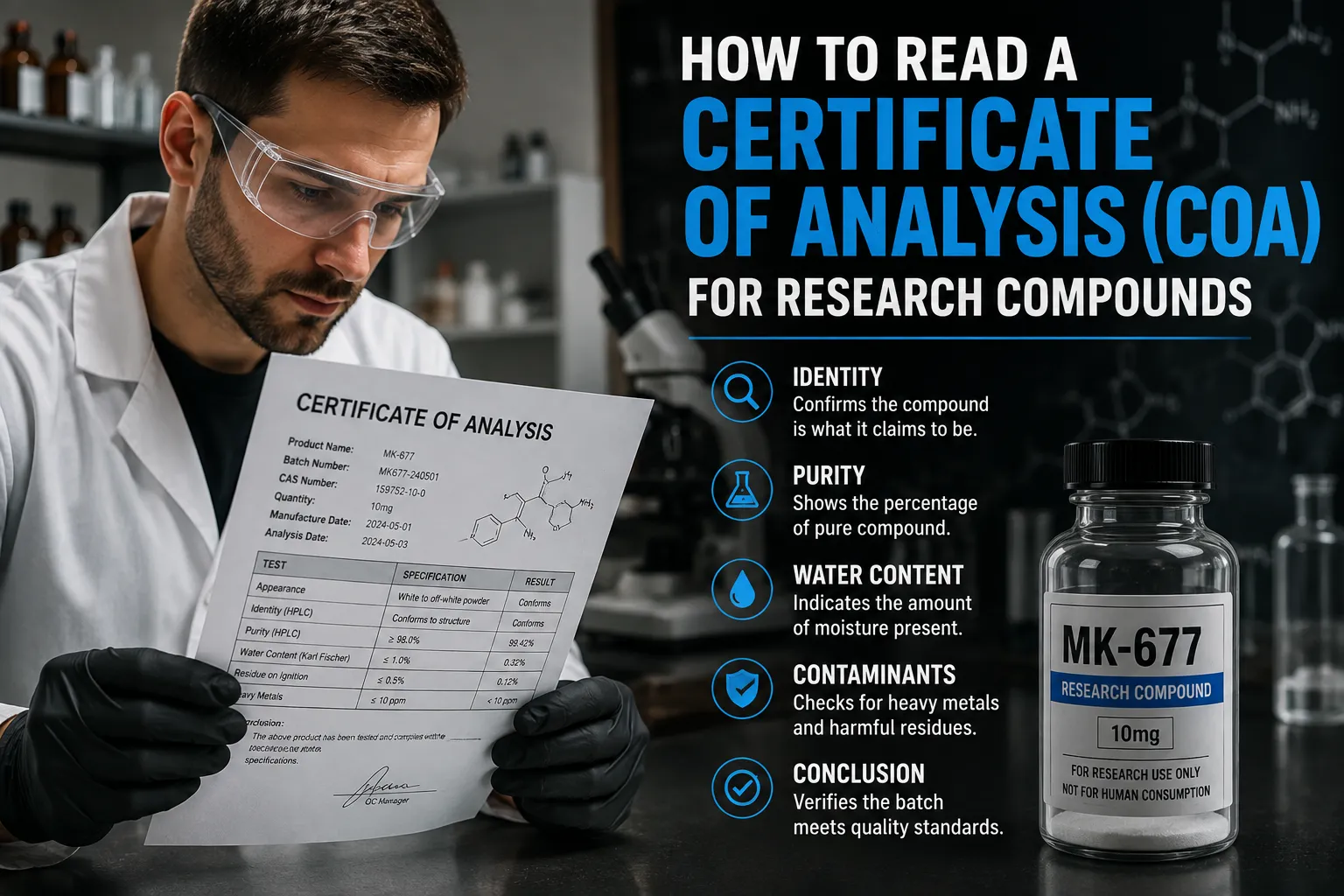
A Certificate of Analysis is the single most useful document available when assessing the quality of a research compound. It is also one of the most frequently faked. Learning to read one properly, and to recognise when one is not what it claims to be, is a core skill for anyone working with these materials.
This guide explains what a certificate contains, how the main analytical methods work, and the practical red flags that indicate a document is unreliable.
What a Certificate of Analysis is
A Certificate of Analysis is a document issued by an analytical laboratory recording the results of tests performed on a specific batch of material. The key word is specific. A certificate describes one batch, tested on one date, by one laboratory. It is not a general statement about a product line, and a certificate for batch A tells you nothing about batch B.
This is why batch traceability matters more than almost anything else. If the batch number on the document does not match the batch number on the material you hold, the document is not evidence about your material.
The elements every genuine certificate should contain
A credible certificate will include most or all of the following:
- Product identification, including the compound name and ideally the CAS number, molecular formula and molecular weight.
- Batch or lot number, being a unique identifier that matches the container label.
- Date of manufacture and date of analysis, stated separately.
- Testing laboratory, with the name and, in a good document, the address and accreditation status of the lab that performed the work.
- Analytical methods used, stated explicitly, for example HPLC for purity and mass spectrometry for identity.
- Specification and result for each test, showing what the acceptance criterion was and what was actually measured.
- Appearance and physical description, for example white lyophilised powder.
- Storage conditions and retest or expiry date.
- Authorisation, with the name, role and signature of the person releasing the certificate.
A document missing several of these is not necessarily fraudulent, but it is incomplete, and incomplete documents should be treated with caution.
Understanding HPLC purity
High Performance Liquid Chromatography is the standard method for assessing purity. In simple terms, the sample is dissolved and pushed through a column that separates its components. Different substances travel through at different speeds, and a detector records each one as it emerges.
The output is a chromatogram, a plot with peaks. Each peak represents a component of the sample. The position of a peak along the horizontal axis is its retention time, which relates to identity. The area under each peak relates to how much of that component is present.
Purity is normally reported as a percentage calculated from peak area, for example 98.6 per cent. This means the main peak accounts for 98.6 per cent of the total detected peak area. It does not mean the remaining 1.4 per cent has been identified, and it does not by itself tell you what the impurities are.
When reading an HPLC result, look for the actual chromatogram image rather than just a number, a clearly dominant main peak, the retention time stated, and the method conditions described. A bare percentage with no chromatogram is weak evidence.
Understanding mass spectrometry
HPLC tells you how much of the main component is present. Mass spectrometry tells you whether that component is the substance it is supposed to be.
The technique works by ionising the sample and measuring the mass to charge ratio of the resulting ions. The observed molecular weight is then compared against the theoretical molecular weight of the target compound. If they match within tolerance, that supports the identity claim.
A certificate that reports purity but never establishes identity has a significant gap. High purity of the wrong compound is not a good outcome. Look for both the theoretical and observed mass to be stated, and for a spectrum to be included.
Tests beyond purity and identity
Depending on the material and its intended application, other tests may appear and are worth understanding:
- Water content, often by Karl Fischer titration. Lyophilised material retains some moisture, which affects both stability and the accuracy of mass based calculations.
- Residual solvents, being traces of solvents used during synthesis and purification, typically assessed by gas chromatography.
- Peptide content or net peptide assay, which distinguishes the actual peptide mass from counter ions and water in the vial. This is different from purity and is frequently omitted.
- Endotoxin, being bacterial pyrogens, typically assessed by LAL testing. Relevant wherever sterility matters.
- Sterility, meaning whether viable microorganisms are present. Note that purity testing says nothing at all about sterility.
- Heavy metals, being elemental impurities carried through from manufacturing.
Documented harms in this sector have included heavy metal exposure and endotoxin reactions, which is precisely why these tests exist and why their absence from a certificate is meaningful.
Third party versus in house testing
There is an important difference between a certificate produced by the manufacturer’s own laboratory and one produced by an independent accredited laboratory with no commercial interest in the result.
In house testing is not inherently untrustworthy, and reputable manufacturers test their own material as a matter of course. But independent verification carries more weight, particularly where the supply chain is long or opaque. The strongest position is in house release testing plus periodic independent confirmation.
When a supplier claims third party testing, the certificate should name the third party laboratory. A document that says “third party tested” without naming the laboratory is making an unverifiable claim.
Applying this across different product types
The principles are consistent, but what you look for shifts with the material. For compounds in the peptides category, net peptide content and endotoxin results carry particular weight, because counter ion and water mass can make a vial contain considerably less active material than the label suggests.
For small molecule compounds such as those in the SARMs category, residual solvents and heavy metals are usually the more informative additional tests, since these reflect the synthesis and purification route.
For consumables and diluents such as bacteriostatic water, the relevant documentation is different again, focusing on sterility, preservative concentration and container integrity rather than chromatographic purity.
Red flags: how to spot an unreliable certificate
These are the warning signs that come up most often:
- No batch or lot number, or a batch number that does not match the material.
- No date of analysis, or a date that predates the manufacture date.
- A flat image with no underlying chromatogram or spectrum. A number typed onto a template proves nothing.
- No analytical method stated.
- Purity reported as exactly 100 per cent. Real analytical results are not perfectly round.
- The same certificate reused across multiple products or batches, sometimes visible from an unchanged chromatogram.
- No named laboratory, no address, no signature or releasing officer.
- Obvious editing artefacts such as mismatched fonts, misaligned text or inconsistent formatting.
- A laboratory that cannot be found or does not confirm the certificate when contacted.
How to verify a certificate
Verification is more straightforward than most people expect. Check that the batch number matches the physical material. Confirm the named laboratory exists and holds the accreditation claimed. Contact the laboratory directly with the certificate number and batch and ask them to confirm they issued it. Reputable laboratories will respond to this.
If a supplier is unwilling to provide a batch specific certificate, or the laboratory will not confirm it, treat that as the answer.
Frequently asked questions
What purity level should a certificate show?
It depends on the compound and application. What matters more than the number is that the method is stated, the chromatogram is included, and the batch is traceable.
Does high purity mean a product is safe?
No. Purity is one attribute. It says nothing about sterility, endotoxin, heavy metals or whether a substance is lawful or appropriate to use.
Is an in house certificate worthless?
Not at all. Manufacturer release testing is standard practice. Independent verification simply adds an additional, more objective layer.
What is net peptide content?
It is the proportion of the vial’s mass that is actually the peptide, as opposed to counter ions and residual water. It is distinct from chromatographic purity.
How should material be stored after checking the certificate?
The certificate states the storage conditions, and those conditions take precedence over any general guidance.
Key takeaways
- A certificate describes one specific batch. Always match the batch number to your material.
- HPLC establishes purity and mass spectrometry establishes identity. You want both.
- Purity says nothing about sterility, endotoxin or heavy metals.
- Named laboratories, stated methods and included chromatograms are the marks of a credible document.
- If a laboratory will not confirm a certificate it supposedly issued, that is your answer.


[…] The quality concern is amplified for a compound with strong consumer demand, because high demand attracts a large and variable supply chain. Products sold outside an evaluated system can vary batch to batch, and the only meaningful way to assess what a specific batch actually contains is through proper testing documentation, which we explain in our guide on how to read a Certificate of Analysis. […]
[…] What purity does not tell you is how much actual peptide is in the vial by mass, or how identity was confirmed, or anything about sterility. It is one attribute among several. The way purity is measured and presented on documentation is covered in detail in our guide on how to read a Certificate of Analysis. […]
[…] Retaining certificates is not just about the moment of purchase. If a question arises later about a result or a batch, the certificate is what allows the material to be characterised retrospectively. We cover what a credible certificate should contain in our guide on how to read a Certificate of Analysis. […]