
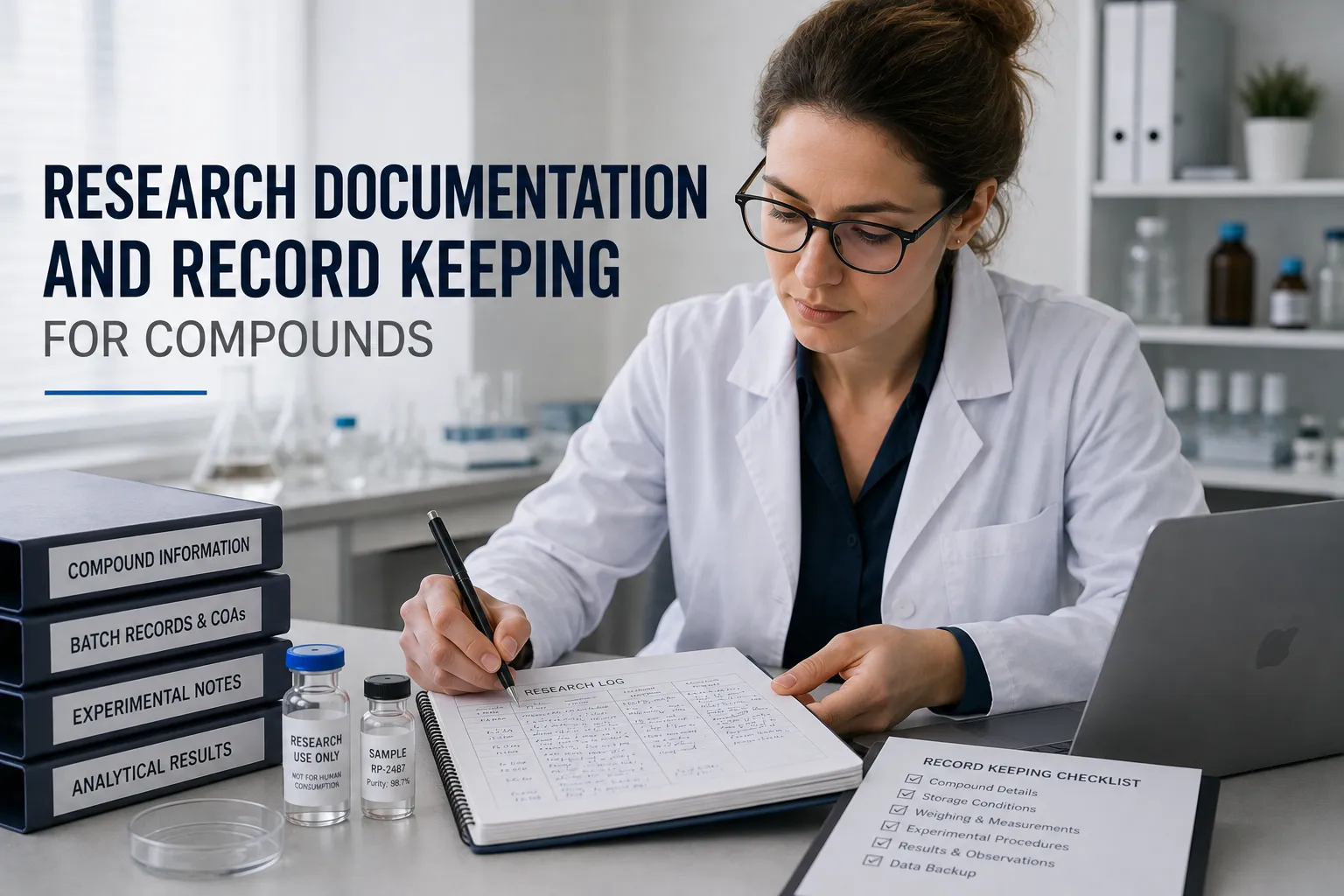
In legitimate research settings, documentation is not an afterthought. It is the thread that connects a compound to its identity, its quality, its handling and its results. Poor record keeping does not just create administrative untidiness. It makes results uninterpretable, undermines quality assurance, and is often the first thing that fails an audit. This guide sets out what good documentation and record keeping look like for research compounds, in practical terms.
This is general information on documentation practice. It is not legal or compliance advice for any specific setting.
Why documentation is the foundation
A research compound is only as trustworthy as the records that accompany it. Without documentation, a vial is an unknown: you cannot be sure what it is, where it came from, how pure it is, or how it has been stored. Every downstream conclusion rests on being able to answer those questions, and the only way to answer them reliably is through records made at the time rather than reconstructed later from memory.
This is why documentation is treated as part of the material itself in serious settings. A compound and its records travel together, and separating them destroys much of the compound’s value.
The Certificate of Analysis
The single most important document is the Certificate of Analysis, which records the test results for a specific batch. It should be retained, and it should be tied to the physical material by a matching batch code. A certificate that cannot be matched to the material in hand is not evidence about that material, however impressive it looks.
Retaining certificates is not just about the moment of purchase. If a question arises later about a result or a batch, the certificate is what allows the material to be characterised retrospectively. We cover what a credible certificate should contain in our guide on how to read a Certificate of Analysis.
Batch and lot records
Batch traceability is the backbone of documentation. Every compound should be recorded against its batch or lot number, and that number should appear consistently across the label, the certificate and your own records. This is what allows a specific production run to be identified, isolated and investigated if a problem emerges.
A batch record should capture, at minimum, the compound identity, the batch number, the source, the date received, and the certificate reference. This modest set of fields is what turns a collection of vials into a traceable inventory rather than an anonymous pile of material.
Receipt and inspection records
Documentation begins the moment material arrives. Good practice records the date of receipt, the apparent condition of the vial and packaging, and any temperature indicators or signs of transit damage. This matters because it establishes the baseline condition of the material before it entered your control.
If a compound later appears degraded, a receipt record showing it arrived in poor condition tells a very different story from one showing it arrived intact. Recording condition on arrival is a small discipline that protects the integrity of everything that follows, and it connects directly to the handling practices in our guide on reconstitution and storage basics.
Storage and handling logs
Once material is in storage, its conditions should be documented. For compounds that require particular storage, this means recording the storage location and temperature, and ideally monitoring that the conditions are maintained. A storage log is what lets you demonstrate that a compound was kept under the conditions its certificate specified.
Handling events matter too. When material is accessed, aliquoted or reconstituted, that should be recorded: the date, what was done, how much was used, and by whom. Aliquot records are particularly valuable, because they let you track single use portions and avoid the freeze thaw damage that comes from repeatedly returning a single container to storage.
Labelling as documentation
Labelling is documentation in its most immediate form. Every container, including every aliquot and every prepared solution, should be labelled with enough information to identify it without reference to anything else: the compound, the batch, the date, and where relevant the concentration. An unlabelled aliquot or solution becomes unusable very quickly, because its contents and age can no longer be established with confidence.
This is one of the most common failures in practice. Material that was perfectly good becomes worthless simply because nobody can any longer be certain what it is or how old it is. A few seconds of labelling at the time prevents that entirely.
Chain of custody
Chain of custody is the record of who has handled a compound and when, from receipt through storage and use to disposal. In rigorous settings it is a formal requirement, and even in less formal ones it is good practice. A clear chain of custody means that at any point you can account for where a compound has been and who was responsible for it.
This is not bureaucracy for its own sake. It is what allows accountability, and it is what an audit or investigation will look for first. A compound with an unbroken, documented custody trail is in a completely different position from one whose history is a series of gaps.
Building a simple record keeping system
Good documentation does not require elaborate systems. A workable approach captures the following, consistently:
- Certificates of analysis, retained and matched to batch codes.
- A batch inventory recording compound, batch number, source and receipt date.
- Receipt records noting condition on arrival.
- Storage logs recording location, temperature and conditions maintained.
- Access and aliquot records noting date, quantity and handler.
- Clear labels on every container, aliquot and solution.
- A disposal record closing out material at the end of its life.
The overhead is modest, and the payoff is substantial: material whose identity, quality and history are known rather than assumed.
Why it matters commercially
For a supplier, documentation practice is also a visible marker of quality. A business that maintains proper batch records, retains certificates and can produce documentation on request is demonstrating the operational discipline that correlates with reliable products. It is one of the things a careful buyer looks for, as set out in our guide on choosing a research compound supplier. Documentation, in other words, is not only an internal good. It is a trust signal that others can see.
Frequently asked questions
What is the most important research document?
The Certificate of Analysis for the specific batch, retained and matched to the material by a batch code. Without it, the material’s quality cannot be characterised.
Why does labelling matter so much?
An unlabelled aliquot or solution quickly becomes unusable because its contents and age can no longer be established. Labelling at the time preserves the material’s usability.
What is chain of custody?
It is the record of who has handled a compound and when, from receipt to disposal. It provides accountability and is what audits look for first.
Do I need elaborate software for record keeping?
No. A consistent set of records covering certificates, batch inventory, receipt condition, storage, access and disposal is sufficient. Consistency matters more than complexity.
How does documentation relate to supplier quality?
A supplier that maintains batch records, retains certificates and produces documentation on request is demonstrating operational discipline, which is a strong quality signal.
Key takeaways
- Documentation is what connects a compound to its identity, quality and history.
- The batch specific Certificate of Analysis is the single most important record.
- Receipt condition, storage logs and access records preserve interpretability.
- Clear labelling on every container prevents material becoming unusable.
- Chain of custody provides accountability and is what audits examine first.

