
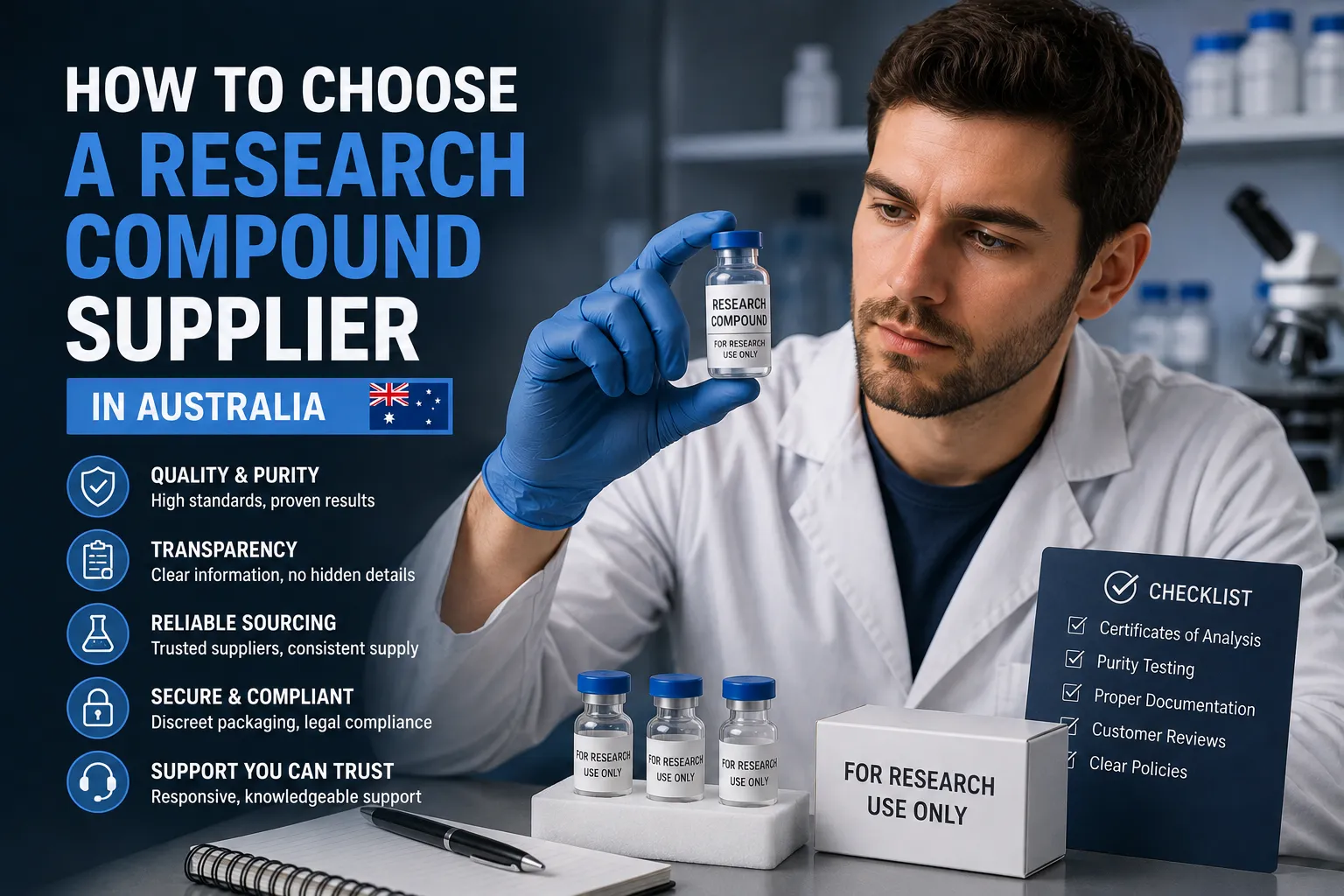
In a market where product quality is invisible to the naked eye and documentation can be fabricated, choosing a supplier is largely an exercise in assessing transparency and process rather than judging the product directly. You cannot see purity, sterility or identity by looking at a vial. What you can assess is whether a supplier behaves like an operation that has nothing to hide. This guide sets out a practical framework for that assessment.
This is general guidance on evaluating suppliers and documentation. It is not legal advice, and nothing here should be read as encouragement to acquire any substance unlawfully.
Why supplier choice matters more than product choice
Because unapproved research compounds sit outside any formal evaluation system, there is no regulator standing behind what is in the vial. That places the entire quality burden on the supply chain, and therefore on the supplier you choose. Two vials with identical labels from different suppliers can be entirely different in reality.
This is why experienced buyers evaluate the supplier as rigorously as the product. A trustworthy process is the only proxy available for a quality that cannot be seen.
Testing transparency
The first and most important signal is testing transparency. A credible supplier provides batch specific certificates of analysis and does not treat them as an inconvenience. The strongest suppliers make documentation easy to obtain and tie it clearly to specific batches.
Look for certificates that name the testing laboratory, state the analytical methods, and include the actual data such as chromatograms rather than a bare percentage. If you are unsure how to interpret these documents, this cluster’s guide on reading a certificate of analysis walks through them in detail. A supplier that is vague about testing, or that offers only generic documents, is telling you something important.
Batch traceability
Traceability is the connective tissue of quality. Every product should carry a batch or lot code that matches its documentation, and a good supplier can produce the certificate for the specific batch you received rather than a representative sample from some other run.
This matters not only for confidence at purchase but for accountability afterwards. If a problem emerges, traceability is what allows it to be investigated. Its absence means there is no mechanism to connect a product back to its production and testing.
Sourcing and quality processes
A supplier’s relationship to its own supply chain tells you a great deal. Operations that qualify their manufacturers, perform incoming checks, and maintain their own quality processes are structurally more reliable than those that simply resell whatever arrives. You will not always see this directly, but a supplier that can speak clearly about its sourcing and quality steps is demonstrating that the processes exist.
Cold chain and handling are part of this. Materials that require particular storage should be handled accordingly throughout, and a supplier that understands and describes its handling practices is more likely to be preserving the integrity of what it sells. The practices described in this cluster’s storage and stability guidance are a useful benchmark for what good handling looks like.
Product range coherence
A coherent, well organised catalogue is a modest but real signal. Suppliers that categorise their products clearly, provide accurate specifications, and maintain consistent documentation across the range are demonstrating operational discipline. You can get a sense of this by browsing how a catalogue is structured, for example whether categories such as the SARMs category, the peptides category and the PCT category are properly separated and accurately described, or whether everything is thrown together with vague listings.
This is not about breadth for its own sake. It is about whether the presentation reflects an organisation that takes accuracy seriously, which tends to correlate with how it treats the harder to see aspects of quality.
Customer support and responsiveness
How a supplier responds to questions is informative. A genuine operation can answer specific questions about testing, documentation, storage and specifications, and does so willingly. Evasiveness, deflection or an inability to answer basic technical questions is a meaningful negative signal.
Responsiveness after a purchase matters just as much. A supplier that stands behind its products and handles issues professionally is operating differently from one that becomes unreachable once payment clears.
Transparency of business identity
Legitimate operations are generally willing to be identifiable. Clear business information, contactable support and consistent presentation are baseline expectations. An operation that conceals its identity entirely, offers no way to make contact, and exists only as an anonymous storefront is asking for a great deal of trust while offering very little in return.
Red flags to avoid
Certain signals should give any buyer pause:
- No batch specific certificates, or only generic documents that never change between batches.
- Certificates with no named laboratory, no method and no underlying data.
- Prices that are dramatically below the rest of the market, which usually reflects what is or is not in the vial.
- Claims of purity stated as exactly 100 per cent, which real analysis does not produce.
- No way to contact a human, or support that cannot answer basic technical questions.
- Pressure tactics, artificial scarcity and marketing that leans on hype rather than specification.
- Inconsistent or copied product information suggesting the catalogue is not genuinely maintained.
A practical evaluation checklist
Before committing to a supplier, work through the following:
- Request a batch specific certificate of analysis and check it names a laboratory, states methods and includes data.
- Confirm products carry batch codes that match their documentation.
- Ask a specific technical question about storage or specification and judge the quality of the answer.
- Assess whether the catalogue is accurately structured and specified.
- Check that the business is identifiable and contactable.
- Be wary of pricing that is far outside the market norm.
Comparing suppliers objectively
When weighing two or more suppliers, it helps to compare them against the same fixed criteria rather than reacting to whichever presents most confidently. Confidence of presentation is not evidence of quality, and some of the least reliable operations market the most aggressively.
A useful method is to score each supplier on the same points: whether batch specific certificates are available, whether those certificates name a laboratory and include data, whether batch codes match documentation, whether the catalogue is accurately structured and specified, whether support answers technical questions competently, and whether the business is identifiable and contactable. Applying an identical checklist to each candidate removes the influence of marketing polish and surfaces the differences that actually matter.
It is also worth giving weight to consistency over time. A single good certificate proves little if the next batch arrives with a generic document. Suppliers worth trusting demonstrate the same standards repeatedly, which is something only ongoing dealing reveals. Treat an initial order partly as a test of whether the documentation and handling match what was promised.
Frequently asked questions
What is the most important thing to check in a supplier?
Testing transparency. Batch specific certificates that name a laboratory, state methods and include data are the strongest single signal.
Are cheaper suppliers usually worse?
Not always, but pricing far below the market norm often reflects what is or is not actually in the product. Treat extreme discounts as a question, not a bargain.
How do I verify a certificate of analysis?
Match the batch code to the material, confirm the named laboratory exists, and contact the laboratory to confirm it issued the certificate.
Does a large product range indicate quality?
Not by itself. What matters is whether the catalogue is accurately structured, specified and documented, which reflects operational discipline.
What is a clear warning sign to walk away?
An inability or unwillingness to provide batch specific documentation, or support that cannot answer basic technical questions.
Key takeaways
- With unapproved compounds, evaluating the supplier is the only proxy for quality you cannot see.
- Batch specific certificates that name a laboratory and include data are the strongest signal.
- Traceability, coherent cataloguing and responsive support all indicate operational discipline.
- Extreme low pricing and anonymous storefronts are consistent red flags.
- Ask specific technical questions and judge the answers before committing.

