
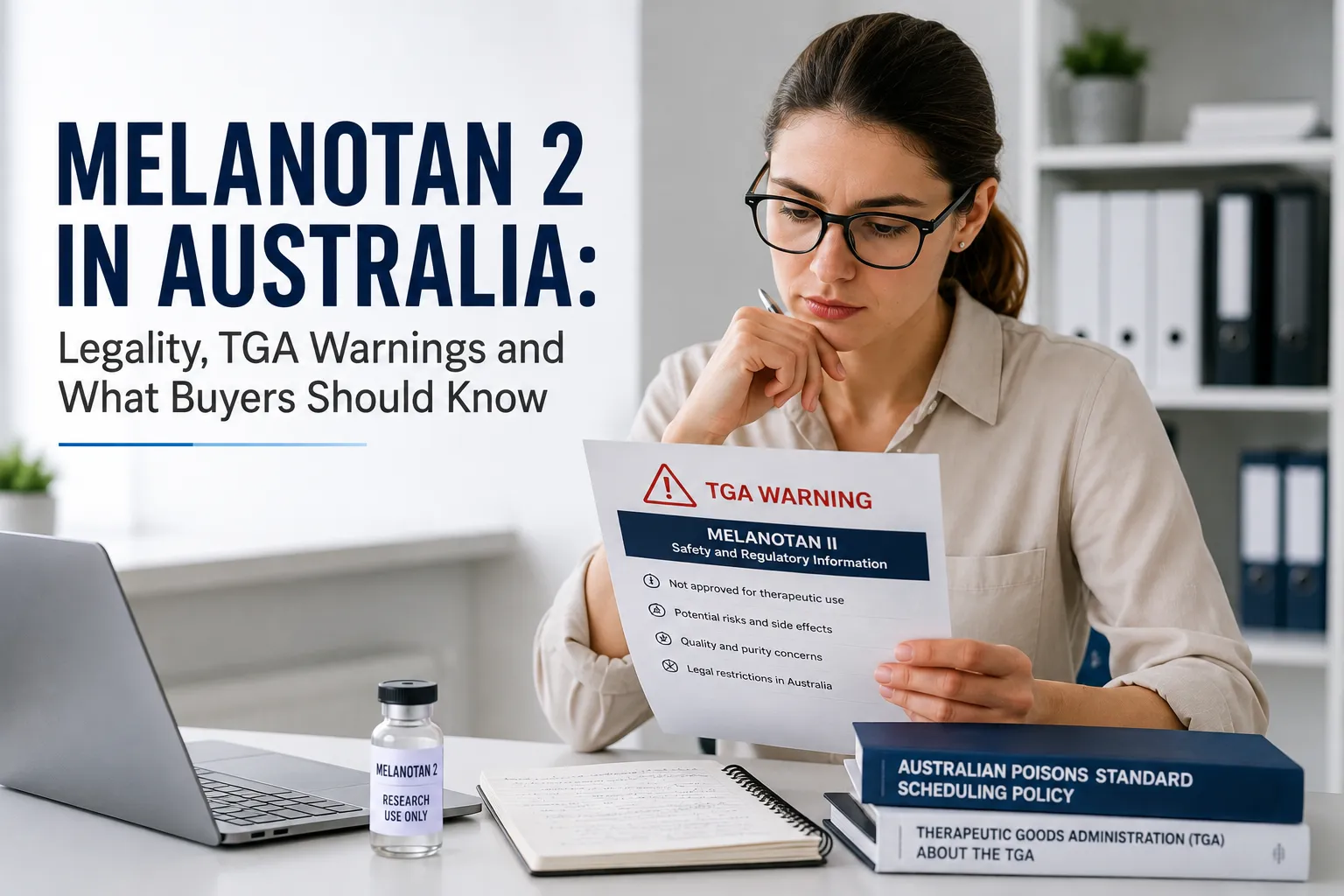
Melanotan 2, often written as MT2, is one of the most searched peptides in Australia, largely because of its association with tanning. It is also one of the compounds the Therapeutic Goods Administration has specifically warned consumers about. Anyone researching this compound should understand its regulatory position, why it carries a warning, and the quality issues that surround it. This guide sets that out plainly.
This is general information for an Australian audience. It is not medical advice, and it does not recommend or endorse the use of any substance.
The short answer
Melanotan 2 is an unapproved substance in Australia. It is not on the Australian Register of Therapeutic Goods for any indication, it is treated as a prescription only substance, and the TGA has issued a specific consumer warning against Melanotan II tanning products. It is not a cosmetic, it is not a supplement, and it is not lawfully available over the counter.
What Melanotan 2 is
Melanotan 2 is a synthetic peptide in the melanocortin family. It is frequently marketed in connection with tanning, which is the basis of most consumer interest in it. It should not be confused with afamelanotide, a separate, related compound that has been through formal regulatory evaluation for specific narrow medical indications. Melanotan 2 as sold in the wider market is not that approved product, and the distinction matters, because the existence of an approved melanocortin medicine does not legitimise the unapproved tanning product.
As a peptide, Melanotan 2 sits within the same broad category as the other compounds discussed across our guides, and it is supplied in the same lyophilised form. It appears in the peptides category on that basis, as a research compound rather than a consumer tanning product.
The TGA consumer warning
The TGA has publicly warned consumers against using Melanotan II tanning products. This is significant, because a named consumer warning is a stronger step than the general unapproved status that applies to many compounds. It reflects specific concern about products being marketed and used for tanning purposes among the general public.
The warning centres on two linked problems. The first is that these are unapproved products that have not been assessed for safety, quality or efficacy. The second is that they are frequently sold and promoted directly to consumers for a cosmetic purpose, which is precisely the kind of use the regulatory framework is designed to prevent for an unevaluated injectable substance.
Why unapproved status matters here
Because Melanotan 2 is not on the Australian Register of Therapeutic Goods, no Australian regulator has verified what a given product contains, how pure it is, or whether it is dosed consistently. This is the same core issue that applies across unapproved peptides, and it is not a technicality. It means the label is a claim rather than a guarantee.
The quality concern is amplified for a compound with strong consumer demand, because high demand attracts a large and variable supply chain. Products sold outside an evaluated system can vary batch to batch, and the only meaningful way to assess what a specific batch actually contains is through proper testing documentation, which we explain in our guide on how to read a Certificate of Analysis.
How it is classified and controlled
Melanotan 2 is treated as a prescription only substance under the Poisons Standard, and as an injectable peptide it also falls within the import controls that make most peptides prohibited imports without a permit. That combination means it is caught by the same two layer control system that applies across this market: scheduling on one hand, and import control on the other. The way those two systems interact is set out in our guide on whether peptides are legal in Australia.
The practical effect is that Melanotan 2 cannot be lawfully imported by an individual without authority, and it cannot be lawfully supplied to the public as a tanning product. Its widespread marketing for cosmetic tanning does not change that position.
The marketing versus regulation gap
Melanotan 2 illustrates a pattern that runs through this whole area. It is often marketed with cosmetic, lifestyle framing that presents it as a simple tanning aid, while its actual regulatory status is that of an unapproved, prescription only injectable substance under a specific consumer warning. The gap between how it is promoted and how it is regulated is wide.
For any business handling this compound, that gap is the compliance risk. Under the Therapeutic Goods Act 1989, advertising an unapproved or prescription only substance to the public is restricted, and cosmetic tanning claims about Melanotan 2 would fall squarely within that restriction. Neutral, factual, non-promotional descriptions are the only defensible approach, a principle we discuss in our guide on what research use only actually means.
What a careful buyer should understand
For anyone researching this compound, several points are worth holding clearly:
- It is unapproved. No Australian regulator has evaluated it for safety, quality or efficacy.
- It carries a specific consumer warning, which is a stronger signal than general unapproved status.
- It is prescription only and a prohibited import without authority, so it cannot be casually or lawfully obtained by an individual.
- Quality cannot be assumed. Only batch specific testing documentation gives any insight into what a product actually contains.
- Cosmetic marketing does not reflect its regulatory reality, and promoting it for tanning is an advertising risk.
These points are not reasons framed to encourage or discourage a personal decision. They are the factual context that the marketing around this compound usually omits.
Handling and storage, if held as a research compound
Where Melanotan 2 is held legitimately as a research material, it behaves like other lyophilised peptides. It should be kept dry, cold and protected from light, and once reconstituted it is far less stable than in its freeze dried form. The general handling principles are the same as for any peptide and are covered in our guide on reconstitution and storage basics. Bacteriostatic water, available on its product page, is one of the diluents used in laboratory settings.
Frequently asked questions
Is Melanotan 2 legal in Australia?
Melanotan 2 is unapproved in Australia. It is treated as a prescription only substance, it is a prohibited import without authority, and the TGA has issued a specific consumer warning against Melanotan II tanning products.
Why did the TGA warn against Melanotan 2?
Because it is an unapproved product that has not been assessed for safety, quality or efficacy, and it is frequently sold and promoted to consumers for cosmetic tanning, a use the framework is designed to prevent for an unevaluated injectable.
Is Melanotan 2 the same as afamelanotide?
No. Afamelanotide is a separate, related compound that has been through formal evaluation for narrow medical indications. Melanotan 2 as sold in the wider market is not that approved product.
Can I import Melanotan 2 for personal use?
As an injectable peptide it is generally a prohibited import without a permit, and it is prescription only. It cannot be casually or lawfully imported by an individual without authority.
How would I know what a Melanotan 2 product contains?
Only through batch specific testing documentation. Because it is unapproved, no regulator has verified its contents, so a Certificate of Analysis is the only meaningful insight into a specific batch.
Key takeaways
- Melanotan 2 is unapproved in Australia and carries a specific TGA consumer warning.
- It is prescription only and a prohibited import without authority.
- It is not the same as the approved compound afamelanotide.
- Quality cannot be assumed and can only be assessed through batch testing documentation.
- Cosmetic tanning marketing does not reflect its regulatory status and is an advertising risk.
Regulatory positions and warnings change. Always check current TGA guidance and seek qualified advice for your own circumstances.

