
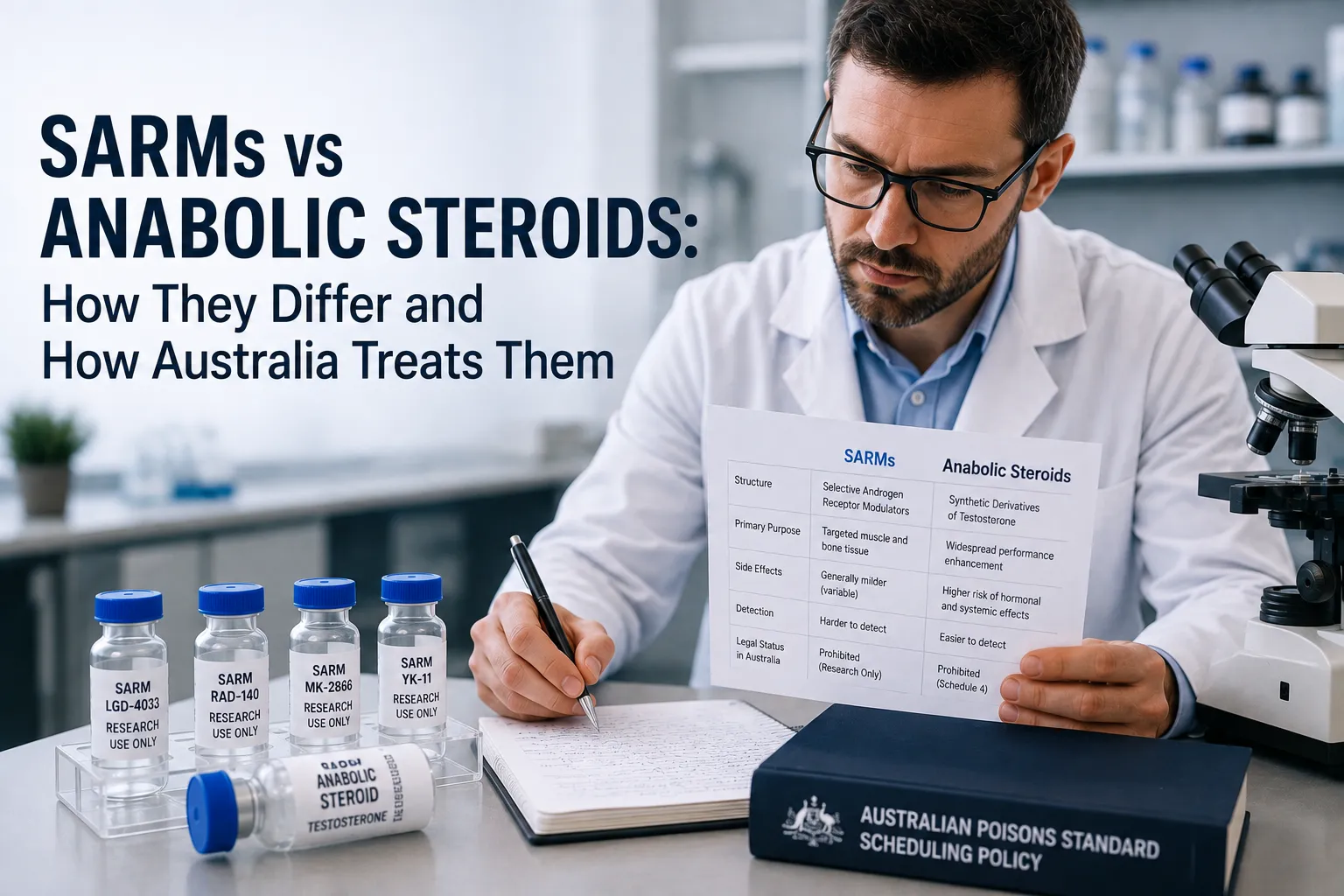
One of the most common questions in this field is how SARMs differ from anabolic steroids. The two are frequently discussed together, marketed to overlapping audiences, and often assumed to be interchangeable or to sit at different points on the same spectrum. In reality they are chemically distinct classes with different mechanisms, and Australian law and anti-doping frameworks treat both seriously. This guide explains the differences plainly and corrects some of the more persistent myths.
This is general information for an Australian audience. It is not medical advice, and it does not recommend or endorse the use of any substance.
The short answer
Anabolic steroids are synthetic derivatives of testosterone that act broadly on androgen receptors throughout the body. SARMs, or selective androgen receptor modulators, are a newer, non-steroidal class designed to act more selectively on certain tissues. Despite the marketing that often frames SARMs as a milder alternative, both are prescription only in Australia, both are prohibited in sport, and both carry recognised risks. The word selective describes a design goal, not a guarantee of safety.
What anabolic steroids are
Anabolic androgenic steroids are synthetic compounds structurally derived from testosterone. Because they are steroidal and act broadly, they influence androgen receptors across many tissues at once, which produces both the anabolic effects they are used for and a wide range of androgenic and systemic effects elsewhere. Their chemistry is well characterised, and their risk profile has been studied over decades.
In Australia, anabolic steroids are tightly controlled substances. Their possession, use and supply without appropriate authority carry significant legal consequences, and they have long been on the radar of both health regulators and law enforcement.
What SARMs are
SARMs are a non-steroidal class. Rather than sharing the steroid backbone, they are a different chemical family designed to bind to androgen receptors with greater tissue selectivity. The concept behind them is to achieve tissue specific effects while reducing action on other tissues, which is where the term selective comes from.
It is important to be precise about what that selectivity means. It is a design intention drawn from how these compounds behave in research settings. It is not a certified clinical safety margin, and it does not mean SARMs are free of systemic effects. Many SARMs remain investigational, and the long term human safety data that exists for older steroids does not exist to the same degree for them. Ibutamoren, often grouped with SARMs, is not a SARM at all but a growth hormone secretagogue, a distinction we cover in our guide on peptide and compound terminology.
The core chemical difference
The cleanest way to summarise the distinction is by structure and selectivity.
- Structure. Anabolic steroids are steroidal, derived from testosterone. SARMs are non-steroidal, a separate chemical class.
- Receptor action. Steroids act broadly across androgen receptors in many tissues. SARMs are designed to act more selectively on particular tissues.
- Maturity of evidence. Steroids have decades of study behind them. Many SARMs remain investigational with less long term human data.
- Marketing framing. SARMs are often positioned as a milder alternative, a framing that outpaces the actual evidence.
That last point matters, because a great deal of the confusion in this area comes from marketing rather than from chemistry.
The myth that SARMs are a safe alternative
The most persistent myth is that SARMs are a risk free or clearly safer substitute for steroids. This framing does not hold up. The selectivity that defines SARMs is a design goal observed in research contexts, not a promise of safety in people, and regulators have not endorsed these compounds as safe for performance or physique use. Treating a compound as harmless because it is newer or marketed as milder is precisely the reasoning the regulatory framework is built to counter.
This is also why both classes are treated as prescription only rather than one being freely available and the other restricted. The law does not recognise the marketing distinction.
How Australia classifies both
In Australia, both classes are prescription only. SARMs are classified under Schedule 4 of the Poisons Standard and are included in Appendix D, which applies additional restrictions. Anabolic steroids are likewise controlled and cannot be lawfully possessed or supplied without appropriate authority. The full scheduling picture for SARMs, including the more restrictive Schedule 9 status of compounds like Cardarine and Stenabolic, is set out in our guide on whether SARMs are legal in Australia.
The practical consequence is that neither class is a legal over the counter option in Australia. Both require a prescription that, for performance or physique purposes, would fall well outside ordinary clinical practice.
How anti-doping treats both
For anyone in tested sport, the comparison collapses entirely, because both classes are prohibited. SARMs and anabolic steroids both fall within the anabolic agents category of the World Anti-Doping Agency Prohibited List, and both are prohibited at all times, in and out of competition. Under strict liability, an athlete is responsible for any prohibited substance in their body regardless of intent.
There is no anti-doping advantage to choosing one class over the other. The detail of how these rules operate, including the strict liability principle and the near impossibility of a therapeutic exemption for unapproved substances, is covered in our guide on SARMs, peptides and anti-doping in Australia.
Why the distinction still matters
If both are prescription only and both are banned in sport, why does the difference matter at all? Because understanding the chemistry helps you read the market critically. A great deal of product marketing leans on the SARMs versus steroids framing to imply a safety or legality gap that does not exist in Australian law. Recognising that the two are distinct chemical classes, but are treated with comparable seriousness by regulators, is what lets you see past that framing.
It also clarifies terminology. Knowing that SARMs are non-steroidal, that ibutamoren is not actually a SARM, and that selectivity is a design concept rather than a safety rating, all help you interpret product pages and discussions accurately rather than at face value.
Frequently asked questions
Are SARMs the same as steroids?
No. Anabolic steroids are steroidal derivatives of testosterone that act broadly. SARMs are a non-steroidal class designed to act more selectively. They are different chemical families.
Are SARMs safer than steroids?
This is not established. The selectivity of SARMs is a design goal observed in research, not a certified safety margin, and many SARMs remain investigational with limited long term human data.
Are both legal in Australia?
Both are prescription only. SARMs are Schedule 4 and included in Appendix D, and anabolic steroids are separately controlled. Neither is a legal over the counter option.
Are both banned in sport?
Yes. Both fall within the anabolic agents category of the WADA Prohibited List and are prohibited at all times under strict liability.
Is MK-677 a steroid or a SARM?
Neither. MK-677, or ibutamoren, is a growth hormone secretagogue, though it is frequently grouped with SARMs in how it is sold and discussed.
Key takeaways
- Anabolic steroids are steroidal and act broadly. SARMs are non-steroidal and designed to act selectively.
- SARMs being marketed as a milder alternative outpaces the actual evidence.
- Both classes are prescription only in Australia, and neither is a legal over the counter option.
- Both are prohibited at all times in sport under the anabolic agents category.
- Understanding the distinction helps you read product marketing critically.

