
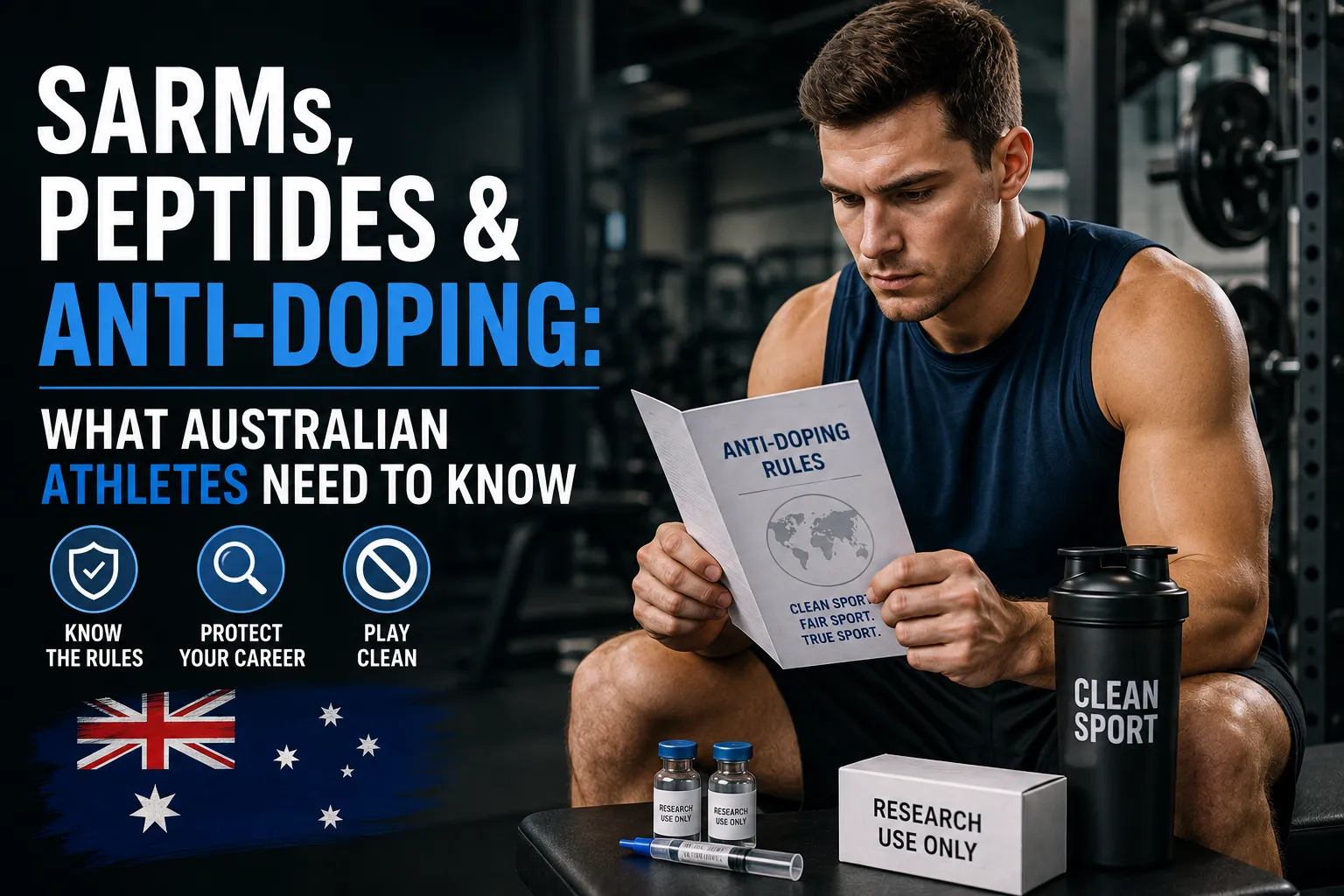
For anyone who competes in organised sport in Australia, the anti-doping framework is a separate and serious layer of rules that sits entirely apart from questions of whether a substance is lawful to buy or possess. A compound can be legally obtained and still end a sporting career. This guide explains how SARMs and peptides are treated under the anti-doping system, why the rules are stricter than most people expect, and where athletes most often come unstuck.
This is general information for awareness only. It is not medical, legal or anti-doping advice, and it does not endorse the use of any substance in or out of sport.
The short answer
SARMs and many peptides are prohibited in sport under the World Anti-Doping Agency framework, which Sport Integrity Australia administers domestically. The 2026 Prohibited List came into force on 1 January 2026. Under it, SARMs fall within the anabolic agents category, and many peptides fall within the peptide hormones, growth factors and mimetics category. Some experimental compounds are captured under the non-approved substances category even if they are not individually named.
The practical consequence is that an athlete who tests positive faces an Anti-Doping Rule Violation, which can carry a lengthy ban regardless of how the substance entered their system.
How the Prohibited List is structured
The Prohibited List sorts substances and methods into categories. The ones most relevant here are:
- Non-approved substances, covering compounds with no approval for human therapeutic use by any regulator. Experimental peptides sold as supplements are captured here.
- Anabolic agents, which includes SARMs alongside anabolic steroids and their esters.
- Peptide hormones, growth factors, related substances and mimetics, which captures a large share of the peptides sold in this market.
- Hormone and metabolic modulators, which includes substances such as aromatase inhibitors and selective estrogen receptor modulators often used in post cycle contexts.
A key point about the List is that it is not exhaustive. A substance can be prohibited even if it is not individually named, provided it fits a category or has no regulatory approval for human use. Assuming something is permitted because it does not appear by name is a common and costly error.
Strict liability: the rule that catches people
The single most important principle in anti-doping is strict liability. Athletes are personally responsible for any prohibited substance found in their body. It does not matter whether the substance was taken deliberately, taken by accident, or arrived through a contaminated product. Intent is generally not a defence to the presence of a prohibited substance.
This is why the framework feels harsh compared with ordinary law. There is no requirement for the prosecuting body to prove the athlete meant to cheat. The presence of the substance is the violation. The athlete’s knowledge or intention may affect the length of a sanction, but it rarely removes the violation itself.
In-competition versus out-of-competition
Some substances are prohibited at all times, both in and out of competition, while others are prohibited only in competition. Anabolic agents, including SARMs, and peptide hormones are prohibited at all times. This means an out-of-competition test taken during a training block can produce a violation just as readily as a test on competition day.
The at-all-times status is significant because it removes the idea of a safe window. There is no period during the training year in which these categories are permitted for a tested athlete.
Therapeutic Use Exemptions
A Therapeutic Use Exemption allows an athlete with a genuine medical need to use an otherwise prohibited substance, provided strict criteria are met and the exemption is granted in advance. It is a legitimate and important pathway, but it is narrow.
For unapproved and unregistered substances, an exemption is very unlikely to be granted. Sport Integrity Australia has made clear that an exemption is improbable for an unregistered medicine, which includes many compounded or unapproved peptides. An athlete who assumes an exemption will cover an unapproved compound after the fact is very likely to be mistaken.
Supplement contamination: the hidden trap
Even athletes who never intend to use a prohibited compound face a real risk from contamination. Products marketed as ordinary supplements have been found to contain prohibited substances that are not declared on the label. Under strict liability, that undeclared contaminant still produces a violation.
Sport Integrity Australia’s guidance is that no supplement is guaranteed safe in sport, and that athletes who choose to use supplements should check whether the specific batch has been independently tested through a recognised program. Batch level verification matters here, because testing of one batch does not certify another. This is the same batch traceability principle that applies to research documentation more broadly, which we cover in the guidance on reading a certificate of analysis linked later in this cluster.
Why the market framing makes this worse
Compounds in this space are frequently marketed to athletes as safe or low risk recovery and performance aids. Sport Integrity Australia has directly warned that peptides are often falsely presented this way, and that they are not harmless supplements. The gap between marketing language and anti-doping reality is where many athletes are misled.
For an athlete, the safest position is to treat any compound in the SARMs category or the peptides category as prohibited unless they have specific, current confirmation otherwise from their anti-doping authority. The same caution applies to substances in the PCT category, since hormone and metabolic modulators are also prohibited and are frequently overlooked because they are not thought of as performance enhancers.
What testing actually involves
Testing can occur in competition or out of competition, and out-of-competition testing can happen with little or no notice. Analytical methods have become highly sensitive, and detection windows for some substances are long. Athletes on registered testing pools also have whereabouts obligations, and failures in those obligations can themselves constitute violations.
Modern detection also extends to metabolites and markers, not just the parent compound, which lengthens the period over which use can be identified. The assumption that a substance clears quickly enough to avoid detection is unreliable and has ended many careers.
Practical guidance for tested athletes
If you are subject to anti-doping rules, a few practices reduce risk substantially:
- Check every substance and medication against the current Prohibited List and your national anti-doping organisation’s tools before use.
- Tell your doctor you are a tested athlete so prescriptions can be checked and any exemption sought in advance.
- Treat unapproved and unregistered compounds as off limits, since exemptions are very unlikely to be available.
- Verify supplement batches through a recognised independent testing program rather than relying on label claims.
- When in doubt about a substance’s status, contact your anti-doping authority before use, not after.
Frequently asked questions
Are SARMs banned in sport?
Yes. SARMs are prohibited at all times under the anabolic agents category of the Prohibited List. A positive test can result in a lengthy ban.
Is BPC-157 prohibited for athletes?
Experimental peptides such as BPC-157 sold as supplements are treated as non-approved substances and are prohibited in sport.
Does intent matter in anti-doping cases?
Under strict liability, the presence of a prohibited substance is the violation. Intent may affect the sanction length but generally does not remove the violation.
Can I get a Therapeutic Use Exemption for peptides?
An exemption is very unlikely to be granted for unapproved or unregistered substances, which includes many compounded peptides.
How can a supplement cause a positive test?
Supplements can contain undeclared prohibited substances through contamination. Under strict liability, the athlete is still responsible for the result.
Key takeaways
- SARMs and many peptides are prohibited at all times in sport under the 2026 Prohibited List.
- Strict liability means the presence of a substance is the violation, regardless of intent.
- Therapeutic Use Exemptions are very unlikely for unapproved or unregistered compounds.
- Supplement contamination can cause violations even without deliberate use.
- When a substance’s status is uncertain, confirm with your anti-doping authority before use.
The Prohibited List is updated annually. Always check the current year’s list and your national anti-doping organisation’s guidance for your own situation.


[…] content, not just products, is within scope. The advertising dimension is covered in our guide on SARMs, peptides and anti-doping in Australia and elsewhere across our compliance […]