
TB500 is a synthetic peptide associated with thymosin beta-4 (Tβ4), a naturally occurring peptide involved in cell movement, tissue repair and inflammation. It has become particularly popular in training and recovery communities because of interest in its potential role in healing, recovery and tissue repair.
You’ll often see TB500 and thymosin beta-4 described as though they’re exactly the same thing. They’re related, but the terminology is messy. Commercial TB500 can refer to a synthetic fragment derived from thymosin beta-4, while much of the published research has actually studied the full-length Tβ4 peptide.
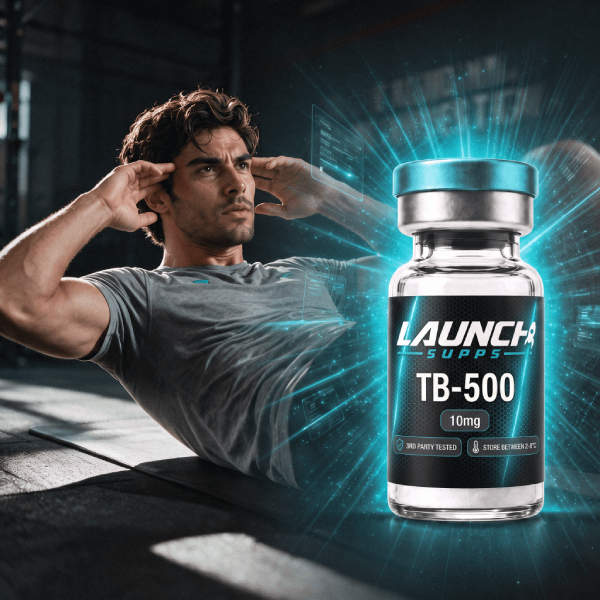
In simple terms: TB500 is mainly discussed as a recovery peptide. Interest centres around helping damaged tissue repair, supporting cell movement and improving recovery after injury or hard training.
What Is TB500?
TB500 is associated with an active region of thymosin beta-4, a peptide naturally found throughout the body. Tβ4 interacts with actin, a protein that forms part of the internal structure of cells and helps cells move.
Cell movement is important during tissue repair because cells involved in healing need to migrate toward damaged areas. Research into thymosin beta-4 has therefore looked at areas including wound healing, blood-vessel formation, inflammation and tissue regeneration.
The important distinction is that research on full-length thymosin beta-4 should not automatically be treated as research on commercial TB500 fragments. The compounds are closely related, but they are not necessarily identical.
TB500 Benefits
Most interest in TB500 revolves around recovery and tissue repair, particularly among people involved in weight training, bodybuilding and sport.
Injury & Tissue Repair
This is probably the main reason people become interested in TB500.
- Tendon injuries
- Muscle strains
- Ligament recovery
- General soft-tissue repair
Training Recovery
TB500 is also discussed by people trying to recover from heavy or frequent training.
- Post-training recovery
- Overuse injuries
- Returning to training
Inflammation & Healing
Thymosin beta-4 research has also generated interest in inflammatory signalling, formation of new blood vessels and the movement of repair cells into damaged tissue.
What Does the Research Show?
Thymosin beta-4 has been studied for its role in cell migration, wound healing, formation of new blood vessels and tissue repair. Its interaction with actin appears to be an important part of these effects.
Research has investigated Tβ4 in areas including skin and wound repair, cardiac tissue and other forms of tissue regeneration.
The evidence specifically for TB500 is much more limited. Many claims made about TB500 online come from research conducted on full-length thymosin beta-4 rather than the exact fragment sold under the TB500 name.
TB500 Dosage
There is no established human clinical dosage for TB500. Protocols found online vary considerably, but they’re commonly discussed in terms of a higher initial weekly amount followed by a lower maintenance amount.
Loading Phase
A commonly discussed approach online is around 4–8mg per week, often divided into two doses, for approximately four to six weeks.
Maintenance Phase
After the initial period, lower protocols around 2–4mg per week are commonly discussed by peptide users.
TB500 Dosage Per Week vs Per Day
TB500 is more commonly discussed using a weekly total rather than a fixed daily dose. Online protocols frequently split the weekly amount across two injections rather than using it every day.
For example, someone discussing a 4mg weekly protocol may describe dividing that into two separate 2mg doses during the week.
Important: these figures describe protocols commonly circulated by peptide users, vendors and practitioners online. They are not clinically established dosing recommendations.
How Long Does TB500 Last?
You’ll often see long half-life figures quoted for TB500 online, but these should be treated cautiously. The terminology around TB500 and thymosin beta-4 is inconsistent, and there is limited human pharmacokinetic research on the specific commercial TB500 fragment.
This is also why most community protocols are described using weekly dosing rather than trying to precisely match a clinically established TB500 half-life.
TB500 vs BPC-157
TB500 and BPC-157 are frequently mentioned together because both are popular in recovery and injury discussions, but they’re generally associated with different mechanisms.
TB500
More closely associated with cell migration and broader tissue repair, based largely on research involving its parent peptide thymosin beta-4.
BPC-157
More commonly discussed around tendon, ligament, muscle and gastrointestinal repair and has a different experimental research background.
Rather than treating one as a direct replacement for the other, peptide communities frequently discuss them as complementary compounds.
BPC-157 and TB500 Together
Combining BPC-157 and TB500 is particularly common in online discussions around injury recovery.
The basic thinking behind the combination is:
- BPC-157 is used with a focus on local tissue and tendon/ligament repair.
- TB500 is used with a broader focus on cell migration and recovery.
There’s enough search interest around this combination that it deserves a separate detailed guide rather than trying to turn this TB500 article into a complete BPC-157 + TB500 protocol.
TB500 Side Effects
Human safety data for the specific TB500 fragment is limited. Experiences reported in peptide communities vary, and many users report little or no noticeable immediate effect.
Effects mentioned in user discussions include:
- Headaches
- Fatigue
- Temporary flushing
- Nausea
- Injection-site irritation
TB500 FAQs
What does TB500 do?
TB500 is mainly discussed in relation to tissue repair and recovery. Much of the biological reasoning comes from research on thymosin beta-4 and its involvement in cell migration, actin regulation and tissue repair.
Is TB500 the same as thymosin beta-4?
Not necessarily. Full-length thymosin beta-4 contains 43 amino acids, while products sold as TB500 may contain a shorter synthetic fragment derived from Tβ4. The names are frequently used interchangeably online even though the compounds can differ.
What is TB500 commonly used for?
Online discussions most commonly focus on injury recovery, tendon and muscle problems, soft-tissue healing and recovery from hard training.
How often is TB500 used?
Community protocols more commonly discuss splitting a weekly amount across multiple doses rather than using a fixed daily protocol. There is no established clinical human dosing schedule for TB500.
Can TB500 and BPC-157 be used together?
The combination is frequently discussed in peptide communities, particularly around injury recovery. However, popularity of the combination should not be confused with evidence from controlled human trials.