
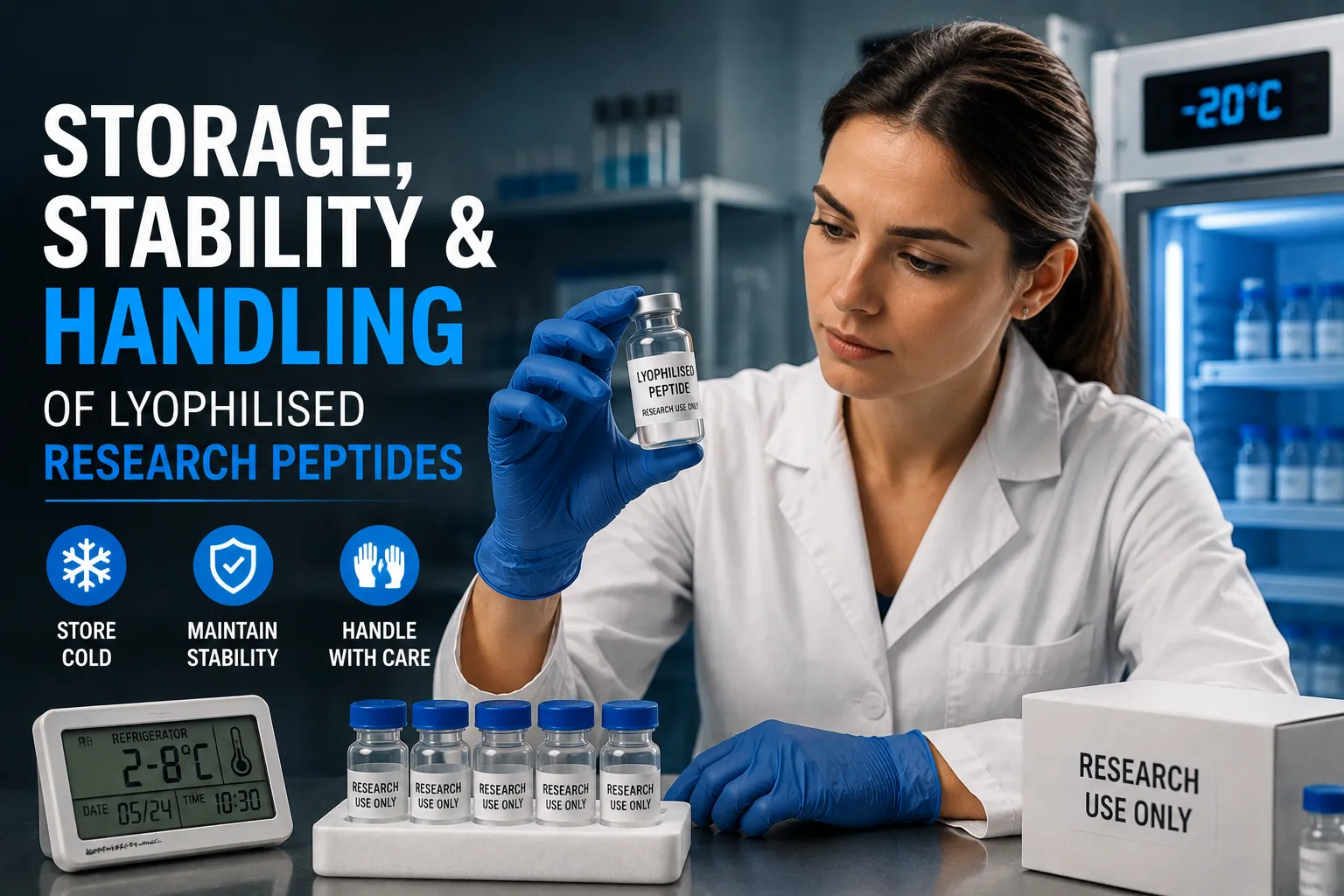
Peptides are chemically fragile. A material that arrives at high purity can degrade substantially within weeks if it is stored poorly, and the resulting loss of integrity is often invisible, because the powder looks the same. For anyone handling these compounds in a laboratory setting, storage discipline is not an afterthought. It is what preserves the value of the material.
This guide covers how lyophilised peptides behave, the conditions that degrade them, and the handling practices that protect them. It is laboratory handling information only.
What lyophilisation is and why it is used
Lyophilisation, also called freeze drying, removes water from a frozen solution by sublimation under vacuum. The result is a dry, porous cake or powder, typically white or off white, that is far more stable than the same peptide in solution.
The reason is straightforward. Most peptide degradation pathways require water. Hydrolysis, deamidation and many oxidation reactions all proceed far more readily in aqueous conditions. Removing water slows these processes dramatically, which is why peptides are almost always supplied in lyophilised form.
This also explains the single most important handling principle: keep the material dry.
How peptides degrade
Understanding the mechanisms helps explain the storage rules:
- Hydrolysis, where water cleaves peptide bonds. Accelerated by moisture, heat and extremes of pH.
- Oxidation, particularly affecting methionine, cysteine and tryptophan residues. Driven by atmospheric oxygen, light and trace metals.
- Deamidation, being conversion of asparagine and glutamine residues. Temperature and pH dependent, and a common route of slow degradation.
- Aggregation, where peptide molecules associate with one another, often triggered by repeated freeze thaw cycles or agitation.
- Adsorption, where peptide binds to container surfaces, reducing the amount actually recoverable, particularly at low concentrations.
Every storage recommendation that follows exists to slow one or more of these processes.
Storage conditions for lyophilised material
General laboratory practice for lyophilised peptides is set out below, though you should always follow the specific conditions stated on the batch certificate, which take precedence.
- Long term storage, typically at minus 20 degrees Celsius or colder. Many laboratories use minus 80 for extended storage of valuable or particularly labile material.
- Short term storage, where 2 to 8 degrees Celsius is generally acceptable for shorter periods.
- Ambient exposure, where brief periods at room temperature during shipping and handling are usually tolerated by lyophilised material, which is considerably more robust than material in solution. This should not be extended unnecessarily.
- Protection from light, using amber vials or opaque secondary packaging. Light drives oxidative degradation, particularly for aromatic residues.
- Protection from moisture, since lyophilised peptides are hygroscopic and will draw water from the air. Sealed containers with desiccant are standard practice.
These conditions apply across the peptides category fairly uniformly, though sequences containing cysteine, methionine or tryptophan warrant extra care because of their oxidation susceptibility.
The condensation problem
This is the most common handling error and it is worth understanding properly. When a cold vial is opened in a warm room, moisture in the air condenses onto the cold contents. That introduces exactly the water the lyophilisation process was designed to remove.
Correct practice is to allow the sealed vial to equilibrate to room temperature fully before opening it. Depending on vial size this may take twenty to thirty minutes. Opening a vial straight from the freezer is a reliable way to compromise material that was otherwise in good condition.
Freeze thaw cycles
Repeated freezing and thawing is cumulatively damaging. Each cycle creates mechanical and chemical stress that promotes aggregation and degradation, and the effect accumulates across cycles.
The standard mitigation is aliquoting, meaning dividing material into single use portions at the outset, so that each portion is subjected to only one freeze thaw event rather than many. Where a stock is intended for repeated use over time, aliquoting at the point of receipt is far better practice than repeatedly returning a single container to storage.
Stability in solution
Once a peptide is in solution, its stability profile changes fundamentally. Solution phase material is markedly less stable than lyophilised material, because all the water dependent degradation pathways become available.
Solutions are generally stored refrigerated and used within a comparatively short window, with the acceptable period depending on the specific peptide, the solvent system and the pH. Some sequences are considerably more labile than others.
Where solutions are prepared, laboratory practice includes using appropriate low adsorption containers, minimising headspace and agitation, and documenting preparation date and conditions. Bacteriostatic water is one of the diluents used in laboratory settings. It contains a preservative intended to inhibit microbial growth, which is distinct from sterile water and is not a substitute for aseptic technique.
Container choice and physical handling
The container matters more than is generally appreciated. Peptides adsorb to surfaces, and at low concentrations the proportion of material lost to container walls can be significant enough to affect results.
Glass is generally preferred for storage of lyophilised material, and amber glass adds light protection. Where plastics are used, low binding polypropylene is standard, and ordinary polystyrene is a poor choice for peptide work. Silanised glassware is used where adsorption is a particular concern.
Physical handling also matters. Vigorous agitation and vortexing introduce shear stress and air liquid interfaces that promote aggregation, particularly for longer sequences. Gentle handling is the rule. Similarly, vials should be stored upright and secured so that seals are not stressed during freezing.
Cold chain and shipping
Lyophilised peptides are routinely shipped at ambient temperature because the dry form tolerates short excursions. That said, a few practices matter:
- Inspect on arrival, confirming the vial is intact, the seal is undisturbed, and the powder appears as described on the certificate.
- Transfer to specified storage promptly, rather than leaving a delivery sitting in a warm environment.
- Record receipt conditions, including date received, apparent condition, and where it was placed. This is basic chain of custody practice.
- Watch for visible changes, since discolouration, clumping or a collapsed cake can indicate moisture ingress or thermal excursion.
Building a storage protocol
Laboratories that handle these materials routinely tend to converge on a similar protocol, which is worth setting out as a checklist:
- On receipt, inspect the vial and packaging, and record the date, apparent condition and any temperature indicators.
- Check the batch number against the accompanying certificate before anything else.
- Record the storage conditions specified on the certificate and apply those specifically, rather than a default.
- Where the material will be used repeatedly, aliquot at the outset while it is in its most stable state.
- Label every aliquot with compound, batch, date and concentration. Unlabelled aliquots become unusable material very quickly.
- Store at the specified temperature, protected from light, with desiccant where appropriate.
- Log every access, recording date opened, quantity removed, and who handled it.
- Allow full equilibration to room temperature before opening, every time.
- Record any observed change in appearance immediately, and quarantine material where integrity is in question.
Supporting consumables matter here too. Sterile single use items such as insulin needles and alcohol wipes are part of maintaining clean handling, and reusing or improvising these undermines everything else in the protocol. The full range of consumables sits alongside the compounds in the main product range.
Shelf life and documentation
A retest or expiry date on a certificate reflects stability under the stated storage conditions. It is a conditional statement rather than an absolute guarantee. Material stored outside those conditions may degrade well before the stated date, and a date on a document does not override observable deterioration.
Good laboratory documentation for stored material includes compound identity and batch number, date received and date opened, storage location and temperature, aliquot records, and any observed changes in appearance. This record is what allows results to be interpreted later, and it is also what a quality audit will look for.
Frequently asked questions
Do lyophilised peptides need refrigeration during shipping?
Lyophilised material generally tolerates ambient shipping for short periods. Refrigerated or frozen storage should resume promptly on arrival.
How long does lyophilised peptide last?
Stored correctly at minus 20 degrees Celsius or below and protected from light and moisture, lyophilised peptides are typically stable for extended periods. The certificate’s retest date is the reference point.
Why must a vial reach room temperature before opening?
To prevent atmospheric moisture condensing onto cold contents, which reintroduces water and accelerates degradation.
Is bacteriostatic water the same as sterile water?
No. Bacteriostatic water contains a preservative intended to inhibit microbial growth. Sterile water does not. They are different products with different specifications and are not interchangeable.
How do I know my material is still good?
Appearance is only a rough indicator. Definitive assessment requires re-analysis against the original certificate specifications.
Key takeaways
- Water drives most peptide degradation, so keeping material dry is the central principle.
- Store lyophilised material at minus 20 degrees Celsius or colder for long periods, protected from light and moisture.
- Always equilibrate a vial to room temperature before opening it.
- Aliquot to avoid repeated freeze thaw cycles.
- Solution phase material is far less stable than lyophilised material.
- Follow the batch certificate’s stated conditions, which take precedence over general guidance.

