
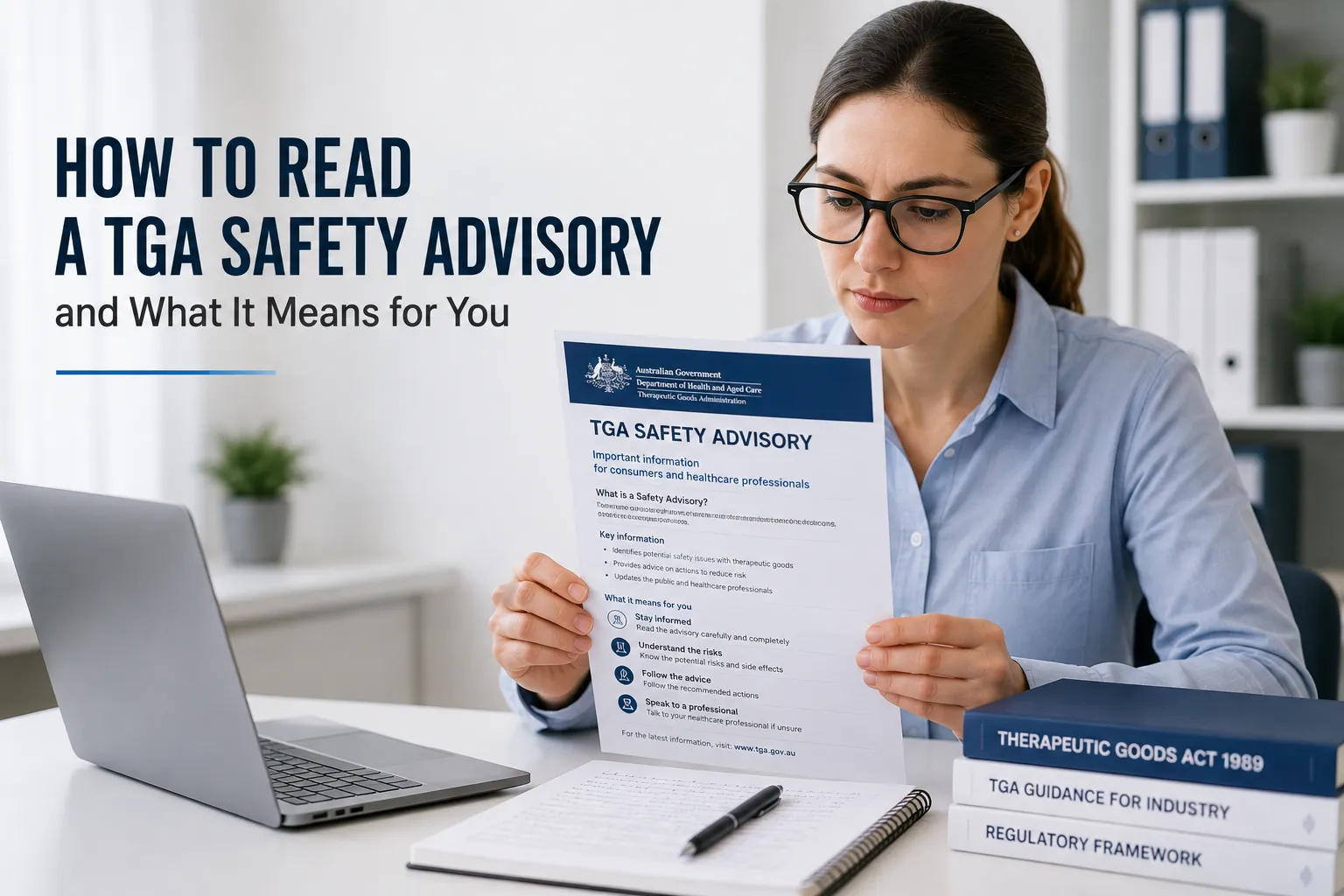
The Therapeutic Goods Administration publishes a steady stream of safety advisories, warnings, alerts and enforcement notices, and this area has been especially active through 2026. For anyone following the research compound space, being able to read these documents accurately is a genuinely useful skill. An advisory is not the same as a recall, and neither is the same as a scheduling change. This guide explains the different kinds of TGA communication and how to interpret them.
This is general information about how to read regulatory communications. It is not legal advice.
Why this matters
TGA communications are the clearest public signal of where regulatory attention is focused. When the regulator names a specific compound in an advisory, or lists a category among its compliance priorities, that tells you something concrete about risk and about where enforcement is likely to fall. Learning to read these documents means you can respond to what the regulator actually said, rather than to secondhand summaries that often distort it.
The main types of TGA communication
The TGA uses several distinct instruments, and they carry different weight.
- Safety advisory or alert. A public communication highlighting a risk, often about a product or class of products. It informs and warns, and it frequently signals that monitoring or enforcement is underway.
- Consumer warning. A direct caution to the public against using a specific product or type of product. This is a pointed step, stronger than a general advisory.
- Recall. A formal action to remove or correct a product already supplied, usually because of a defect or safety issue. Recalls concern approved products in the market far more than unapproved ones.
- Scheduling decision. A change to how a substance is classified in the Poisons Standard. This changes the law around a substance rather than simply warning about it.
- Compliance and enforcement action. Concrete steps such as infringement notices, seizures or court action taken against specific conduct.
Confusing these is common. An advisory warns, a scheduling decision reclassifies, and an enforcement action penalises. They are different tools with different consequences.
What a safety advisory actually tells you
When the TGA issues a safety advisory about a compound or class, it is usually communicating several things at once. It identifies a risk, it clarifies regulatory status, and it often signals intent. The April 2026 advisory on unapproved peptide products is a clear example. It named specific compounds, confirmed that none was approved for any indication, and stated that the regulator was actively monitoring from both a safety and a law enforcement perspective.
Reading that carefully, three distinct messages are present: these products are unapproved, they carry safety concerns, and enforcement is a live possibility. An advisory that names compounds by name is doing more than offering general caution. It is telling you where the regulator is looking.
Advisory versus scheduling: a key distinction
A safety advisory does not itself change a substance’s legal classification. A compound’s scheduling is set in the Poisons Standard, and it changes only through a formal scheduling decision. An advisory can precede, accompany or follow such a decision, but the two are separate. This matters because people sometimes read an advisory as if it were a new law, or dismiss it because it is not one. Neither reading is correct. An advisory is a warning and a signal, and it sits alongside the scheduling framework rather than replacing it.
To understand the legal status of a compound, you look to the Poisons Standard and the import regulations. To understand the regulator’s current concern and likely enforcement focus, you look to advisories and compliance priorities. Both are needed for a full picture, as we set out in our guide on what research use only actually means.
Compliance priorities: the enforcement roadmap
Each year the TGA publishes compliance priorities, which are effectively a roadmap of where enforcement effort will concentrate. When a category appears on that list, it is a strong signal that activity in that area will increase. Unapproved therapeutic goods, including unapproved peptides, and products supplied through e-commerce and social media have featured prominently in recent priorities.
The stated approach has also broadened to include action against false and misleading online information, influencer content and deceptive endorsements. For anyone marketing in this space, that is a direct signal that promotional content, not just products, is within scope. The advertising dimension is covered in our guide on SARMs, peptides and anti-doping in Australia and elsewhere across our compliance guides.
How to interpret an advisory in practice
When you encounter a TGA advisory, a few questions help you extract what it actually means:
- What exactly is named? A specific product, a named compound, or a whole class. The more specific, the more pointed the concern.
- What status does it confirm? Whether the products are approved, unapproved, or falsified changes everything that follows.
- Does it signal enforcement? Language about monitoring, law enforcement or compliance action indicates that warnings may be followed by penalties.
- Is it a warning or a legal change? An advisory warns. Check the Poisons Standard separately for the actual classification.
- Who is the audience? Consumer warnings speak to the public, while some communications are aimed at sponsors, suppliers or health professionals.
Answering those turns a document that can feel alarming or vague into a clear read on risk and status.
Why this literacy protects you
For a buyer, reading advisories accurately means understanding the real status and risk of a compound rather than relying on marketing or forum chatter. For a business, it means seeing enforcement trends early and adjusting conduct before an advisory becomes an enforcement action. Either way, going to the primary source and reading it carefully is far more reliable than absorbing a distorted secondhand version, which is how most misunderstandings in this area begin.
Frequently asked questions
What is a TGA safety advisory?
It is a public communication from the regulator highlighting a risk, often about a product or class of products. It informs and warns, and frequently signals that monitoring or enforcement is underway.
Does a safety advisory change the law?
No. Legal classification changes only through a scheduling decision in the Poisons Standard. An advisory is a warning and a signal that sits alongside the scheduling framework.
How is an advisory different from a recall?
A recall is a formal action to remove or correct a product already supplied, usually an approved product with a defect. An advisory is a warning, often about unapproved products.
What are TGA compliance priorities?
They are the regulator’s annual roadmap of where enforcement effort will concentrate. A category appearing on the list signals increased activity in that area.
Where do I check a compound’s actual legal status?
In the Poisons Standard for scheduling, and in the Customs (Prohibited Imports) Regulations for import status. Advisories tell you about concern and enforcement focus, not classification.
Key takeaways
- Advisories, consumer warnings, recalls, scheduling decisions and enforcement actions are different tools with different weight.
- A safety advisory warns and signals intent but does not itself change the law.
- Compliance priorities are the clearest roadmap of where enforcement will fall.
- Recent priorities explicitly include online marketing, influencer content and unapproved products.
- Reading the primary source is far more reliable than secondhand summaries.
Regulatory communications are published regularly. Always read the current advisory directly and check the Poisons Standard for classification.

