
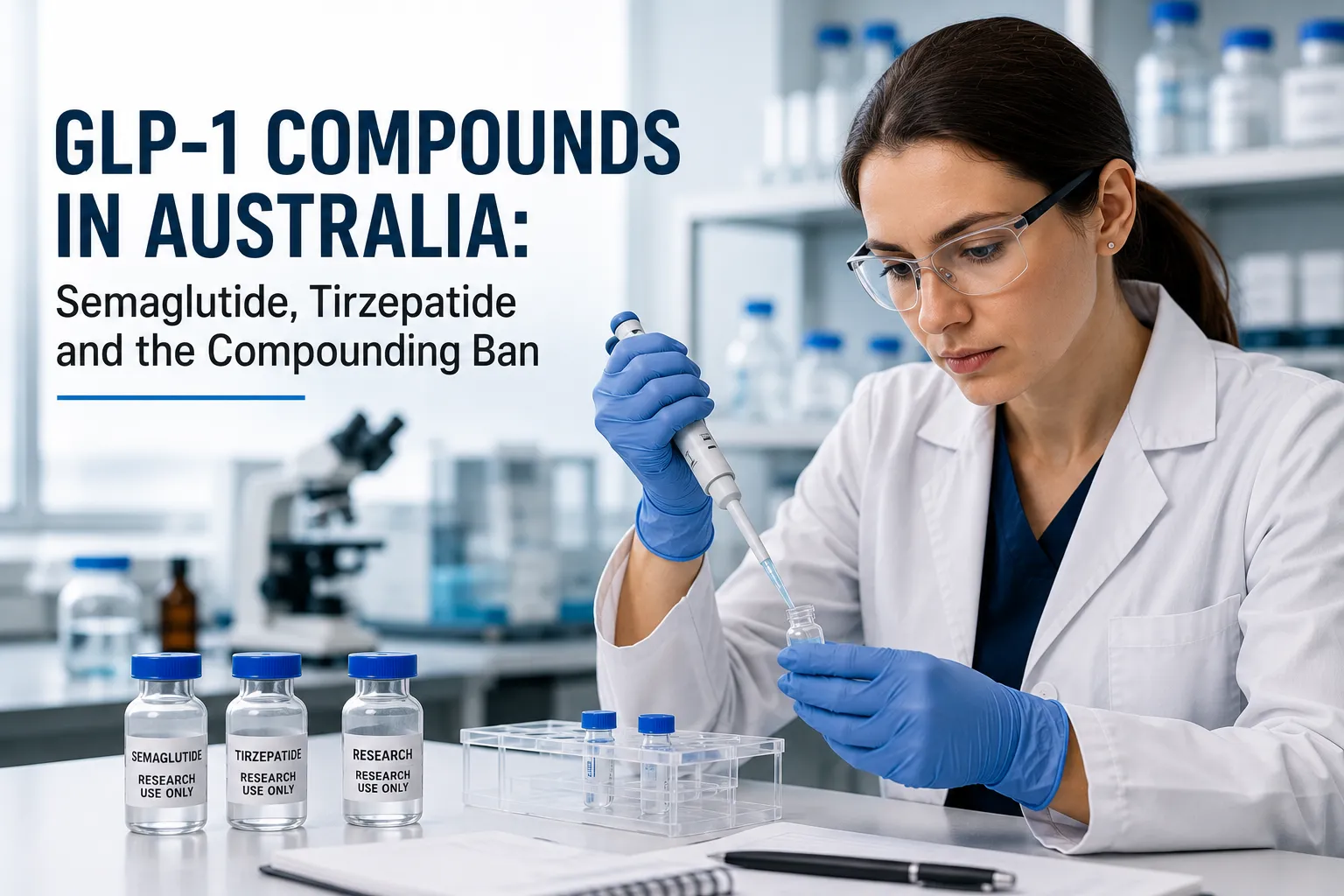
Few areas of the therapeutic goods landscape have moved as quickly, or attracted as much regulatory attention, as GLP-1 compounds. Semaglutide, tirzepatide and newer molecules such as retatrutide are among the most searched substances in Australia, and around them has grown a large market of compounded and unapproved copies. The rules governing this space changed significantly in 2024 and have tightened further through 2026. This guide explains where things stand, in plain language.
This is general regulatory information for an Australian audience. It is not medical, legal or regulatory advice, and it does not recommend or endorse the use of any substance.
The short answer
Semaglutide and tirzepatide are GLP-1 receptor agonists. In their approved forms they are Schedule 4 prescription only medicines, available through normal pharmacy channels against a valid prescription. Compounded copies of these molecules are a different matter. Since 1 October 2024, pharmacies have been prohibited from compounding GLP-1 receptor agonist products, and unapproved copies sold online or through some clinics sit outside the regulatory framework. Newer molecules such as retatrutide have no approved product in Australia at all and were named by the TGA among unapproved peptide products under active monitoring.
What GLP-1 receptor agonists are
GLP-1 receptor agonists are peptide compounds that mimic glucagon-like peptide-1, a gut hormone that signals satiety, slows gastric emptying and stimulates insulin release in response to meals. Semaglutide acts on a single receptor pathway, while tirzepatide acts on two, and retatrutide is being studied as a triple pathway agonist. They are, chemically, peptides, which is why they are frequently discussed alongside the wider peptide market even though the approved versions are formal, evaluated medicines.
This dual identity is the source of much of the confusion. The same molecule can exist as an approved, registered medicine dispensed by a pharmacy and, separately, as an unapproved compounded or imported copy sold outside that system. They are not the same product in any sense that matters to a regulator.
Approved versus unapproved: the crucial line
The distinction that governs everything here is whether a specific product has been evaluated by the Therapeutic Goods Administration and entered on the Australian Register of Therapeutic Goods. An approved product has been through a formal assessment of safety, quality and efficacy. An unapproved copy has not, which means no Australian regulator has verified what it contains, how pure it is, or whether it is dosed accurately.
Approved semaglutide and tirzepatide products exist in Australia and are prescribed for specific indications. The controversy is not about those. It is about the parallel market of compounded and imported copies that carry the same molecule names but none of the evaluation.
The 2024 compounding ban
For a period, some pharmacies produced compounded versions of semaglutide and tirzepatide, often marketed through telehealth platforms at lower prices, relying on a pharmacist compounding exemption. That changed decisively. From 1 October 2024, amendments to the Therapeutic Goods Regulations 1990 removed all medicines containing GLP-1 receptor agonist analogues, including semaglutide, tirzepatide and related molecules, from the extemporaneous compounding exemption.
The ban was deliberately comprehensive. It applied regardless of dosage form, covering injectable, oral and topical preparations alike, and it applied to all compounding on or after the commencement date with no grandfather provisions for existing stock. The stated rationale was to protect the public from unsafe compounding of replica weight loss products.
Enforcement has followed. In 2025 the TGA accepted a court enforceable undertaking from a compounding pharmacy in relation to advertising these products, which signalled that the advertising dimension is being pursued alongside the compounding prohibition itself.
Why the regulator treats these as high risk
The concern is not merely procedural. GLP-1 injectables are sterile, high risk medicines in the same broad class as insulin, and replicating the precision required for consistent concentration, sterility and stability outside a validated manufacturing environment is technically demanding. The TGA has pointed to several specific hazards.
- Dose accuracy. Compounded products are not subject to the same batch testing as registered medicines, so concentrations that are too high or too low present direct clinical risk.
- Sterility. Contamination during preparation presents a direct infection risk for injectable products.
- Stability. Shelf life and storage requirements of compounded versions may differ from validated registered products.
- Unexpected ingredients. Some compounded products have been found to combine the named molecule with other substances.
These are the same categories of risk that apply to unapproved peptides generally, which is why the quality verification principles in our guide on how to read a Certificate of Analysis are so relevant to this whole area.
Imported copies and the falsified product problem
Alongside domestic compounding, a large volume of GLP-1 style products has been imported, much of it purchased online. This raises a distinct and serious problem. In March 2026 the TGA issued a safety advisory after laboratory testing confirmed that several imported unregistered weight loss products, which falsely claimed to contain GLP-1 receptor agonists or analogues, did not contain what their labels stated.
This is the falsified product problem in its clearest form. When a product sits outside the evaluated supply chain, the label is a claim rather than a guarantee, and testing has repeatedly shown those claims to be unreliable. The border risks that attach to importing these products are covered in a dedicated guide on importing research compounds into Australia.
Where retatrutide and newer molecules sit
Retatrutide is a newer GLP-1 class molecule that has attracted intense interest but does not have an approved product in Australia. It was named by the TGA among the unapproved peptide products flagged in its April 2026 safety advisory, alongside compounds such as BPC-157, GHK-Cu, TB-500 and CJC-1295. In regulatory terms, this places it in the most restrictive practical position of the group: no approved product exists, and it is under active monitoring.
The broader point is that novelty cuts against a compound here rather than for it. The less established a molecule is, the less evaluation exists, and the more the entire quality and safety burden rests on an unverified supply chain. The regulatory framework treats these substances with more caution, not less, as they get newer.
The wellness framing problem
A recurring theme in TGA commentary is the use of wellness language to soften or sidestep the rules that apply to therapeutic goods. GLP-1 style products are frequently promoted online and on social media with claims relating to weight loss, muscle growth, anti-ageing and athletic performance. The regulatory question is whether that framing is being used to obscure the fact that these are therapeutic goods subject to advertising restrictions.
For any business operating in the wider research compound space, this is the key compliance lesson. Neutral, factual, non-therapeutic language is not merely a stylistic preference. Under the framework, promotional or therapeutic claims about prescription only or unapproved substances are exactly what shifts content into prohibited advertising. The same principle runs through our guide on what research use only actually means.
Frequently asked questions
Is compounded semaglutide legal in Australia?
Pharmacies have been prohibited from compounding GLP-1 receptor agonist products, including semaglutide, since 1 October 2024. Approved semaglutide products remain available on prescription through normal pharmacy channels.
Are semaglutide and tirzepatide prescription only?
Yes. In their approved forms they are Schedule 4 prescription only medicines, available against a valid prescription from an Australian prescriber.
Is retatrutide approved in Australia?
No. Retatrutide has no approved product in Australia and was named among unapproved peptide products in the TGA’s April 2026 safety advisory.
Why did the TGA ban GLP-1 compounding?
The stated reason was to protect the public from unsafe compounding of replica weight loss products, citing risks around dose accuracy, sterility and stability.
Are imported GLP-1 copies reliable?
Testing has repeatedly shown otherwise. In March 2026 the TGA confirmed that several imported unregistered products falsely claiming to contain GLP-1 agonists did not contain what their labels stated.
Key takeaways
- Approved semaglutide and tirzepatide are Schedule 4 prescription medicines available through pharmacies.
- Pharmacy compounding of GLP-1 receptor agonists has been prohibited since 1 October 2024, with no grandfathering.
- Retatrutide has no approved product in Australia and is under active TGA monitoring.
- Imported copies have repeatedly failed testing, sometimes not containing the labelled molecule at all.
- Wellness framing does not remove advertising obligations for therapeutic goods.
This is a fast moving area. Always check current TGA guidance and seek qualified medical and legal advice for your own circumstances.

