
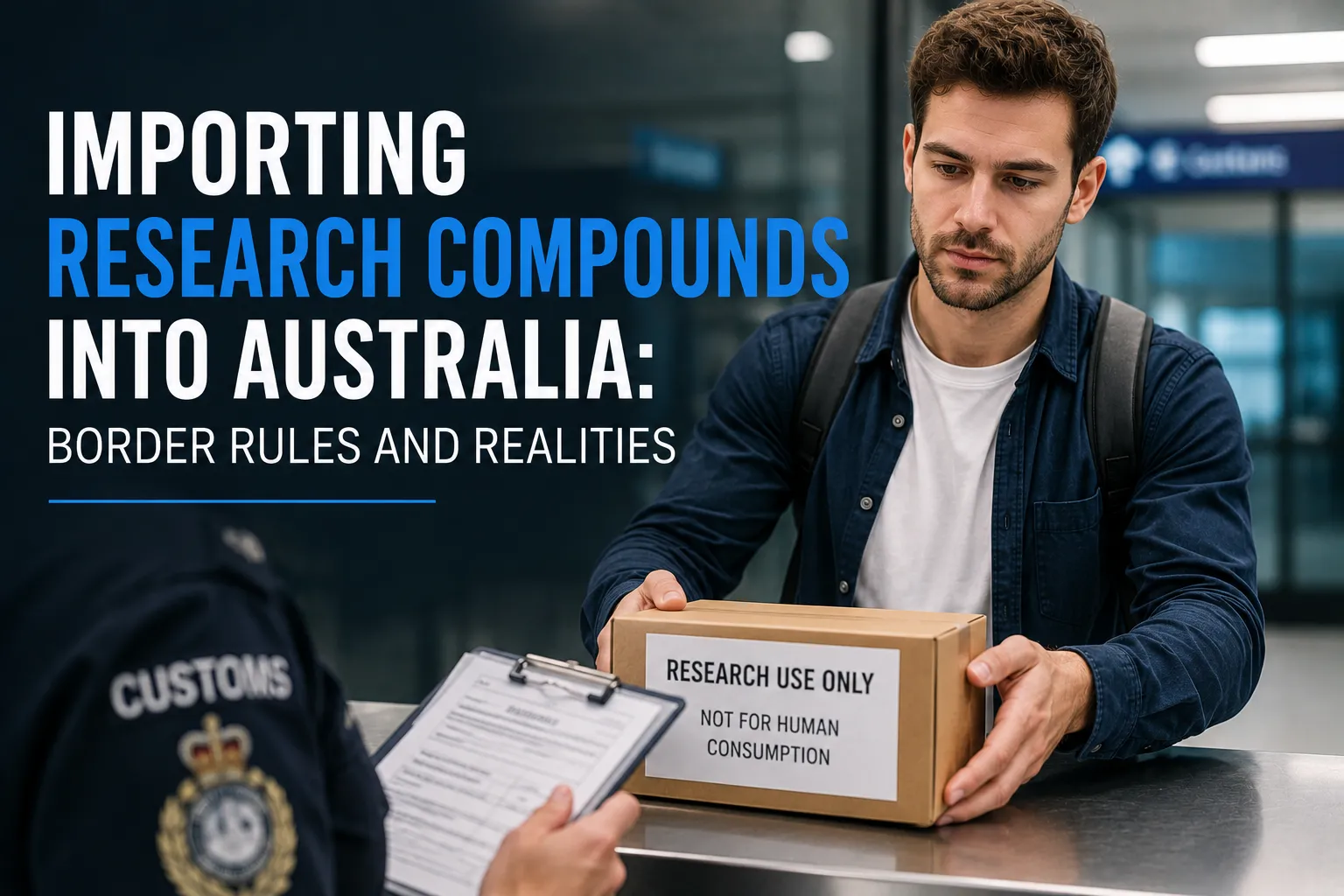
Few areas of this subject are as widely misunderstood as importation. There is a persistent belief that a personal importation allowance, a research use label, or simply a small order size will carry a shipment safely through the border. The reality in 2026 is considerably harder, and the level of enforcement has risen sharply. This guide explains how the border controls actually work, what the Personal Importation Scheme does and does not permit, and why seizures have become common.
This is general regulatory information, not legal advice. It does not encourage or facilitate unlawful importation of any substance.
The short answer
Most research compounds in this market cannot be lawfully imported into Australia by an individual without specific authority. Many are prescription only under the Poisons Standard, and most peptides are prohibited imports under Schedule 7A of the Customs (Prohibited Imports) Regulations 1956 unless the importer holds a permit. Where the required authority is absent, the goods are liable to seizure, and the consequences can extend beyond simply losing the parcel.
Two separate control layers
The first thing to understand is that two distinct systems apply at once, and clearing one does not clear the other.
- Scheduling under the Poisons Standard determines whether a substance is prescription only or prohibited. This governs possession and supply within Australia.
- Import controls under the Customs (Prohibited Imports) Regulations 1956 determine whether a substance may cross the border at all. Schedule 7A captures most peptides as prohibited imports absent a permit.
A substance can be caught by one, the other, or both. This is why a compound that is not obviously a controlled drug can still be stopped at the border: the import control operates independently of the schedule.
How the Personal Importation Scheme really works
The Personal Importation Scheme is the provision most often cited and most often misunderstood. It does allow individuals to import certain unapproved therapeutic goods for personal use, but only where a strict set of conditions is met at the same time.
The core conditions include that the goods are for personal use or that of an immediate family member and are not to be sold or supplied to anyone else, that quantities are limited to a defined supply period, and that prescription medicines are covered by a valid prescription. The TGA has been explicit that if a valid written authority cannot be produced, the products will be seized at the border.
Crucially, the scheme does not transform a prohibited import into a permitted one. A substance that requires an import permit under Schedule 7A still requires that permit. The scheme is not a blanket exemption, and it does not authorise commercial importation in any form. For a business, it offers nothing at all, because any commercial intent falls outside it immediately.
Why research use labelling does not help at the border
A common assumption is that a laboratory or research use label smooths importation. In practice it can do the opposite. A vial labelled for laboratory or research use arriving at a residential address, with no documented institutional affiliation, is exactly the profile that attracts scrutiny rather than deflecting it. The label signals a therapeutic style product while the delivery context signals personal use, and that mismatch is a red flag rather than a shield.
The reason ties back to intended purpose, a concept covered in this cluster’s explanation of what research use only actually means. Labelling describes intent. It does not create the institutional authority that genuine research importation requires, and it does not change a substance’s import classification.
Legitimate import pathways
There are lawful routes for importing unapproved goods, but they are structured and documented, not casual. They exist for clinical and research contexts rather than personal purchase, and each carries its own requirements.
- The Personal Importation Scheme, for genuine personal use within its strict conditions, which does not cover prohibited imports needing a permit and does not cover any commercial activity.
- Import permits for substances captured by Schedule 7A, which must be obtained from the regulator before the goods are shipped.
- Institutional and research pathways, which involve documented protocols, evidence of professional or institutional affiliation, ethics approval where relevant, and prior authorisation before shipment.
- Clinical access and trial pathways, for investigational goods used under the appropriate schemes.
The common thread is that authority is obtained in advance and can be produced on request. An import that relies on nothing being checked is not using a pathway. It is simply hoping to avoid inspection.
The enforcement reality in 2026
The level of activity in this area has escalated in a way that makes the border a genuine chokepoint rather than a theoretical one. The Australian Border Force refers imports suspected of containing unlawful therapeutic goods to the TGA for assessment, and where products are found to be illegal imports, appropriate compliance action is taken and the goods are destroyed.
The scale is significant. A global enforcement operation reported in May 2026 resulted, domestically, in the seizure of more than 900,000 units of unlawfully imported therapeutic goods in Australia, alongside the removal of thousands of pieces of online content advertising and selling such products. Separately, a joint operation involving the TGA, the Australian Border Force and state police led to the seizure of a large quantity of peptide products, performance and image enhancing drugs and illicit steroids with an estimated street value in excess of two million dollars, and to criminal charges against individuals alleged to be importing performance and image enhancing drugs.
The TGA has also formally added unapproved peptide products to its published compliance focus areas, describing a deliberate shift from consumer education toward active enforcement. In plain terms, this is no longer an area where lax importation goes unnoticed.
What actually happens when goods are stopped
When a shipment is intercepted, the typical outcome is forfeiture and destruction of the goods, along with the loss of whatever was paid for them. Beyond that, the matter may be referred for further action. Depending on the substance, the quantity and the circumstances, responses can include infringement notices, import interventions and, where appropriate, civil or criminal penalties.
For an individual, the most common experience is the quiet loss of a parcel and the money spent on it, sometimes accompanied by a letter. For anyone importing at scale or for supply, the exposure is materially greater, because volume and commercial intent move a matter from a border seizure toward an enforcement case.
Why buying domestically changes the picture
One practical consequence of all this is that the border risk sits with whoever imports. A domestic purchase from a business that has already handled importation and compliance does not place the border risk on the buyer in the same way, because the goods are not crossing the border on the buyer’s behalf. This is one reason buyers increasingly prefer suppliers operating within Australia rather than ordering directly from overseas.
That preference makes supplier selection more important rather than less, because the buyer is now relying on the domestic supplier’s sourcing, compliance and quality processes. This cluster’s guidance on choosing a research compound supplier sets out how to evaluate that. It is also worth understanding how products are categorised and specified domestically, whether across the SARMs category, the peptides category or the PCT category, since a well run domestic catalogue reflects the compliance discipline that importation demands.
Frequently asked questions
Can I import peptides for personal use in Australia?
Most peptides are prohibited imports under Schedule 7A unless the importer holds a permit. The Personal Importation Scheme has strict conditions and does not override that permit requirement.
Does the Personal Importation Scheme cover research chemicals?
Only within its strict conditions, for genuine personal use, and never for commercial purposes. It does not convert a prohibited import into a permitted one.
Will a research use label get goods through customs?
No. A research or laboratory label arriving at a residential address without institutional affiliation tends to attract scrutiny rather than avoid it.
What happens if my parcel is seized?
The goods are typically forfeited and destroyed, and the money paid is lost. Depending on circumstances, the matter may be referred for further regulatory or law enforcement action.
Is buying within Australia different?
A domestic purchase does not place the border import risk on the buyer in the same way, though it makes the domestic supplier’s compliance and quality processes more important.
Key takeaways
- Two separate systems apply: scheduling and import controls. Clearing one does not clear the other.
- The Personal Importation Scheme is narrow, conditional, and never covers commercial importation.
- Research use labelling does not help at the border and can attract scrutiny.
- Enforcement escalated sharply in 2026, with large seizures, content takedowns and criminal charges.
- Seized goods are typically destroyed, with further action possible depending on circumstances.
Import rules and enforcement priorities change. Always check current TGA and Australian Border Force guidance, and seek qualified advice for your own situation.
[…] Personal Importation Scheme. A narrow provision allowing personal import of some unapproved goods under strict conditions, explained in the guide on importing research compounds into Australia. […]