
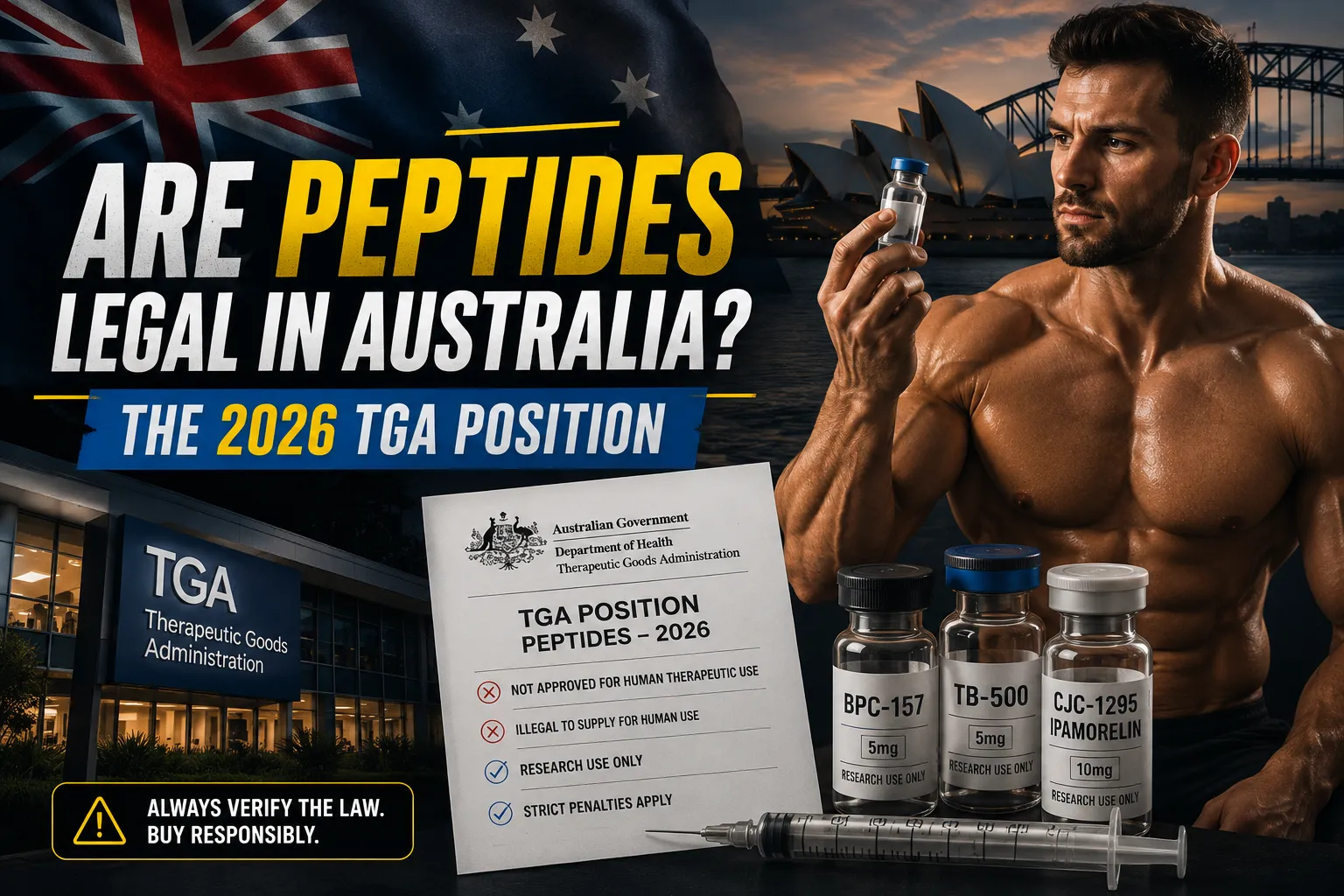
The legality of peptides in Australia is not a simple yes or no. It depends on which specific peptide you are talking about, whether it has been approved by the regulator, and critically, what it is intended to be used for. This guide sets out the current position as at 2026, including the significant regulatory developments of April 2026.
This is general regulatory information rather than legal or medical advice. It does not endorse the use of any unapproved substance.
The short answer
Peptides are not inherently illegal in Australia. Some peptide medicines are fully approved and widely prescribed, with insulin being the most familiar example. What determines legality is whether a particular peptide product has been evaluated and entered on the Australian Register of Therapeutic Goods, and how it is being imported, supplied, advertised or used.
Most injectable peptides that are not on the register fall into the category of unapproved therapeutic goods. Many are also Schedule 4 prescription only substances, and a large number are prohibited imports unless the importer holds a permit.
What ARTG approval actually means
The Australian Register of Therapeutic Goods lists products that have been assessed by the TGA for safety, quality and efficacy. A product on the register has been through a formal evaluation. A product that is not on the register has not, which does not automatically mean it is dangerous, but it does mean no Australian regulator has verified what it contains, how pure it is, or whether it works as claimed.
This distinction is the foundation of everything else. When the TGA refers to unapproved peptide products, it means products that have not been assessed or included on the register.
The April 2026 TGA safety advisory
On 13 April 2026, the TGA issued a safety advisory flagging a sharp rise in the import, supply, compounding and advertising of unapproved peptide products across Australia. The advisory named specific compounds, including BPC-157, GHK-Cu, TB-500, retatrutide and CJC-1295.
The advisory made several points clear. None of the named products has been evaluated by the TGA for safety, quality or effectiveness. None is approved for any indication in Australia. And the TGA confirmed it is actively monitoring the issue from both a safety and a law enforcement perspective.
Four areas of activity were identified as being of regulatory concern:
- Importing. Bringing unapproved peptide products into Australia without appropriate authority is unlawful.
- Compounding. Pharmacies compounding these substances face specific restrictions.
- Supplying. Supply of unapproved therapeutic goods is restricted and can attract enforcement.
- Advertising. Promoting prescription only or unapproved therapeutic goods to the public breaches the Therapeutic Goods Act 1989.
The TGA has already issued infringement notices in connection with this area. For businesses, the advertising limb is often the most immediate exposure, because it is triggered by marketing language rather than by the product itself.
Scheduling and import controls
The TGA maintains the Poisons Standard, which classifies most injectable peptides as Schedule 4 prescription only medicines. This classification exists so that substances with meaningful pharmacological effects are used under practitioner supervision.
Separately, most peptides are listed under Schedule 7A Item 3 of the Customs (Prohibited Imports) Regulations 1956. Under those regulations, Schedule 7A substances are prohibited imports unless the importer holds a permit issued by the TGA. This is a distinct control layer from scheduling, and it catches a great many products at the border.
The breadth of this is worth appreciating. It applies across the whole peptides category, covering growth hormone secretagogues such as ipamorelin, repair peptides, metabolic peptides and melanocortin peptides such as melanotan 2. The controls are not limited to the compounds that happen to be in the news.
The Personal Importation Scheme is narrower than people think
The Personal Importation Scheme is often cited as a lawful route for individuals. It is much narrower than commonly assumed. It does not authorise the import of prescription only medicines for supply or clinical use, and it carries conditions around quantity, prescription status and the nature of the goods.
Relying on the scheme without meeting its conditions does not create a lawful import. Goods may be seized, and the matter may be referred for further action.
Why manufacturing quality is a genuine concern
Beyond legality, there is a quality question that deserves attention on its own merits. Because unapproved products sit outside the evaluation process, nothing guarantees what is in the vial.
This is not theoretical. In April 2026 the US Food and Drug Administration issued a warning letter to a Chinese active pharmaceutical ingredient producer manufacturing bulk peptides including BPC-157, CJC-1295, ipamorelin, tesamorelin acetate and TB-500 acetate. The letter identified major sterility violations, and the producer was added to an import alert. Other warning letters have cited manufacturers for failing to test ingredients for purity, strength and quality.
Documented harms associated with contaminated or substandard peptide products include heavy metal exposure, endotoxin reactions and infections arising from non sterile preparation. These risks are a direct consequence of operating outside an evaluated supply chain.
Approved versus unapproved: a useful mental model
It helps to separate peptides into three practical groups:
- Approved and registered. Evaluated by the TGA and on the register. Insulin and certain approved GLP-1 receptor agonist medicines fall here, available on prescription through normal clinical channels.
- Prescription only but unapproved in this form. The molecule may be known to medicine, but the specific product has not been evaluated or registered in Australia.
- Unapproved and unevaluated. Compounds such as those named in the April 2026 advisory, which have no register entry for any indication.
The further down that list a product sits, the more the regulatory burden and the quality uncertainty rest on whoever handles it.
What this means for buyers and businesses
The practical consequence of the 2026 position is that risk in this sector has shifted decisively toward the supply and promotion side. For individuals, the exposure is largely at the border and in the quality of what they receive. For businesses, the exposure is broader and considerably more expensive.
Three areas account for most enforcement activity. The first is importation without the required permit, which is the most mechanical to detect because goods physically cross a border. The second is supply of unapproved therapeutic goods, which attracts attention when volume or visibility rises. The third, and the one most often overlooked, is advertising.
Advertising exposure is triggered by language rather than by the transaction. Product descriptions, blog content, social posts, influencer arrangements and even customer testimonials can constitute advertising of therapeutic goods. Because the Therapeutic Goods Act 1989 prohibits advertising prescription only substances to the public, a business can be compliant in how it sources and stores its stock while still being exposed through how it describes it.
How to check a specific substance
If you need to establish the position for a particular peptide, the process is reasonably direct:
- Check the register for an entry matching the exact product, not just the molecule name. A registered product from one sponsor does not legitimise an unregistered product containing the same compound.
- Check the Poisons Standard for the substance’s schedule, and note that entries can be substance specific or class based.
- Check Schedule 7A of the Customs (Prohibited Imports) Regulations 1956 to determine whether an import permit is required.
- Check current TGA safety advisories, which are published as issues emerge and may name specific compounds.
- Check the WADA Prohibited List if sport participation is relevant.
These are separate checks with separate outcomes. A substance can be unscheduled but still a prohibited import, or lawfully prescribable but prohibited in sport. Establishing one does not establish the others.
Peptides and anti-doping
For competitive athletes, a separate framework applies. Many peptides, including growth hormone secretagogues and various growth factors, are prohibited under the WADA Prohibited List. Sport Integrity Australia administers anti-doping domestically. Anti-doping rules apply independently of whether a substance was lawfully obtained.
Frequently asked questions
Is BPC-157 legal in Australia?
BPC-157 is not approved by the TGA for any indication and was specifically named in the April 2026 safety advisory. It is not lawfully available for human use in Australia.
Can I import peptides for personal use?
Most peptides are prohibited imports under Schedule 7A of the Customs (Prohibited Imports) Regulations unless the importer holds a TGA permit. The Personal Importation Scheme does not provide a general workaround.
Are all peptides unapproved?
No. Several peptide medicines are approved and registered. The issue concerns products that have not been evaluated or registered.
Does a “research use only” label make a peptide legal?
No. Labelling does not change a substance’s scheduling or import status, and it does not create authority that would not otherwise exist.
How do peptides differ from SARMs legally?
They are monitored separately, though both are commonly Schedule 4. The compounds in the SARMs category sit under their own scheduling history and advisories.
Key takeaways
- Legality depends on the specific peptide, its register status, and the intended use.
- The TGA’s 13 April 2026 advisory named BPC-157, GHK-Cu, TB-500, retatrutide and CJC-1295 as unapproved products under active monitoring.
- Importing, compounding, supplying and advertising are all identified enforcement areas.
- Most injectable peptides are Schedule 4 and are prohibited imports without a permit.
- Quality risk is a real and documented issue outside evaluated supply chains.
Regulatory positions change quickly in this area. Check current TGA guidance and obtain qualified advice for your own situation.

